This post contains affiliate links. If you purchase through our links, we may earn a small commission at no extra cost to you.
Best Non-Toxic Dish Soap That Actually Cuts Grease (2026)
I stood in the cleaning aisle for a solid ten minutes once — flipping bottles, squinting at ingredient lists, putting them back down. Every single one said “plant-based” or “natural” on the front. Every single one had synthetic fragrance buried on the back.
Here’s what I eventually learned: non-toxic dish soap isn’t just about what’s missing from the label — it’s about what’s hiding behind vague words like “fragrance” and “surfactant blend.” By the end of this guide, you’ll know exactly which three ingredients to avoid, which certification actually means something, and which soap cuts through a greasy pan without compromising what goes on your plates.
- Avoid these three: synthetic fragrance, SLS/SLES, and DMDM Hydantoin — on any dish soap label, full stop.
- Best overall: Branch Basics Concentrate — EWG Verified, MADE SAFE Certified, genuinely lasts for months.
- Best zero-waste: Blueland Dish Soap — refillable bottle, dissolvable tablets, no single-use plastic ever.
- Best budget pick: ECOS Dish Soap — EWG Verified and usually under $5 at most stores.
- EWG Verified is the only label worth filtering by first — everything else is marketing until proven otherwise.
The 3 Ingredients Hiding in “Clean” Dish Soaps That Aren’t Clean at All
This is the part that changes everything — because once you know these three, you’ll spot them in under 30 seconds on any label.
Real talk: most of the “natural” dish soaps I tried before I knew better had at least one of these. I felt good about buying them. I shouldn’t have.
- Synthetic fragrance (listed as “fragrance” or “parfum”): One word. Thousands of possible chemicals behind it — including phthalates, which disrupt hormones (at the concentrations typically found in household products). If the scent source isn’t named, it’s hiding something.
- SLS and SLES (sodium lauryl sulfate / sodium laureth sulfate): These are the foaming agents (surfactants that create lather) responsible for that satisfying foam. SLES in particular may be contaminated with 1,4-dioxane during manufacturing (at the concentrations typically found in household products). And here’s the thing nobody puts in these guides: foam doesn’t mean clean. It’s just foam.
- DMDM Hydantoin: A preservative that slowly releases formaldehyde (a known carcinogen) over time. It shows up in more dish soaps than you’d expect. It has absolutely no business being near your food.
You’ve probably grabbed a bottle with one of these and wondered if it really mattered. It does — and now you can spot it fast.
Knowing what to avoid gets you halfway there — the next section covers which certifications actually back up a clean claim versus which ones are just good graphic design.
The Certifications That Actually Mean Your Dish Soap Is Safe (And the Ones That Don’t)
Not every green logo on a bottle means the same thing — and a few of them mean almost nothing at all.
I’ll be honest: I trusted the leaf icons and the pastel packaging for way longer than I should have. “Plant-based” fooled me completely until I realized it’s a marketing term with zero legal definition. These certifications, though, require actual third-party verification.
“Plant-based is a marketing term. EWG Verified is a third-party standard. Only one of them requires proof.”
Once you know which certifications carry real weight, finding a safe dish soap takes less time than reading this sentence twice.
The Best Non-Toxic Dish Soaps That Actually Cut Grease — Tested and Ranked
Every soap on this list had to pass two tests: clean ingredient list and real-world grease-cutting ability — because a soap that’s safe but useless on a skillet isn’t worth your money.
I’ve tried more of these than I’d like to admit. Some smelled amazing and did nothing. Some looked sketchy and worked brilliantly. Here’s what actually held up.
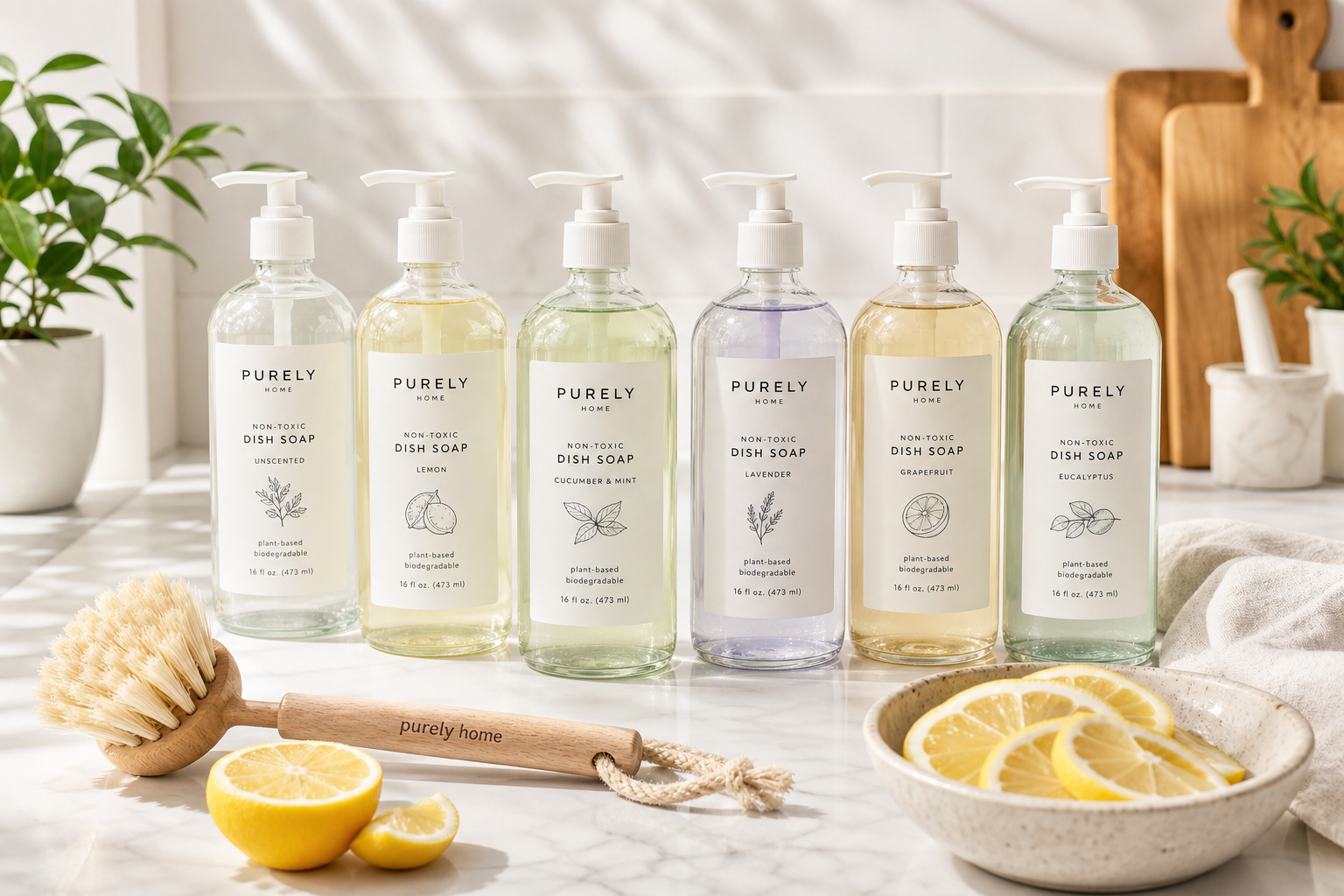
Branch Basics Concentrate — Best Overall
Branch Basics concentrate is the one I keep coming back to — genuinely. One bottle makes multiple refills of dish soap, laundry detergent, all-purpose spray, and produce wash. It’s 100% biobased, EWG Verified, MADE SAFE Certified, and Leaping Bunny approved. No synthetic fragrance. No sulfates. No fillers.
I was skeptical that one concentrate could actually replace everything under my sink. It does — and the dish soap version handles a greasy roasting pan without a second pass.
My top pick for anyone who wants to simplify their cleaning routine and actually trust what’s in the bottle — one concentrate, five products, months of use.
Blueland Dish Soap — Best Zero-Waste Pick
I was skeptical about Blueland’s tablet format — a dissolvable tablet that turns into dish soap in a refillable bottle. Now I won’t go back. No single-use plastic, ever. The formula cuts grease well and is free from SLS, SLES, and synthetic dyes.
One thing to watch: stick to their fragrance-free version. Some scented options still use synthetic fragrance compounds — which defeats the whole point.
The cleanest zero-waste swap I’ve found — one pretty bottle, endless tablet refills, and a formula that actually tackles a dinner pan.
Dr. Bronner’s Pure-Castile Liquid Soap — Best Budget Pick
Dr. Bronner’s has been making the same transparent formula since 1948 — castile soap (made from plant oils rather than synthetic detergents) that’s biodegradable, fair-trade certified, and free from SLS, synthetic fragrance, and preservatives. It’s also genuinely affordable and concentrated.
Fair warning: it doesn’t foam like conventional soap. And yes, that threw me off the first time. But the dishes come out just as clean — warm water and a little patience is all it needs.
A no-frills, no-nonsense clean formula that’s been around longer than most of us — affordable, multi-use, and genuinely effective on grease with warm water.
Seventh Generation Free & Clear — Best First Swap
If you’re just starting out and want the easiest possible swap — grab this one. It’s fragrance-free, dye-free, plant-derived, and available at Target, Walmart, and Amazon right now. No special ordering, no waiting.
One important note: stick specifically to the Free & Clear line. Other Seventh Generation formulas do contain SLS — so the label matters even within the same brand.
The most accessible non-toxic swap at any grocery store — genuinely clean on the label, easy to find, and a great starting point if you’ve never made this switch before.
ECOS Dish Soap — Best EWG Verified on a Budget
ECOS is one of the few dish soaps that’s EWG Verified and regularly priced under $5. The formula is plant-derived, pH balanced, free from synthetic dyes and fragrance, and manufactured in a climate-neutral facility. That combination is genuinely rare at this price point.
My go-to recommendation for anyone who wants a certified clean formula without spending premium prices — it’s the easiest argument-winner for skeptical partners.
Attitude Dishwashing Liquid — Best Naturally Scented Option
Here’s what nobody puts in these guides about scented soaps: you don’t have to go fragrance-free to go non-toxic. Attitude uses only naturally derived scents — named essential oils, no phthalates, no synthetic fragrance compounds. The formula is EWG Verified and hypoallergenic.
And yes, I’ve tested this myself — it handled a wok full of stir-fry residue without a second round. The light scent makes the whole sink experience noticeably nicer (I know that sounds small, but it isn’t).
The pick for anyone who genuinely loves a scented dish soap but doesn’t want the toxin trade-off — EWG Verified, naturally fragranced, and effective on real grease.
Side-by-Side: Which Non-Toxic Dish Soap Is Right for Your Home
Use this table to find your match fast — sorted by what matters most to your situation.
| Product | Best For | Price Range | Top Certification | Choose This If… |
|---|---|---|---|---|
| Branch Basics Concentrate | Best overall + multi-use | $$–$$$ | EWG Verified + MADE SAFE | You want one cleaner to replace everything |
| Blueland Dish Soap | Zero-waste households | $$ | Plastic-free + dissolvable | You’re eliminating single-use plastic |
| Dr. Bronner’s Castile Soap | Budget + multi-use | $ | Fair Trade + biodegradable | You want simple, affordable, and proven |
| Seventh Generation Free & Clear | First-time switchers | $ | Plant-derived + fragrance-free | You want to start today with zero friction |
| ECOS Dish Soap | EWG Verified on a budget | $ | EWG Verified + climate neutral | You want certified clean without the premium |
| Attitude Dishwashing Liquid | Naturally scented option | $$ | EWG Verified + hypoallergenic | You love a scented soap but hate the toxins |
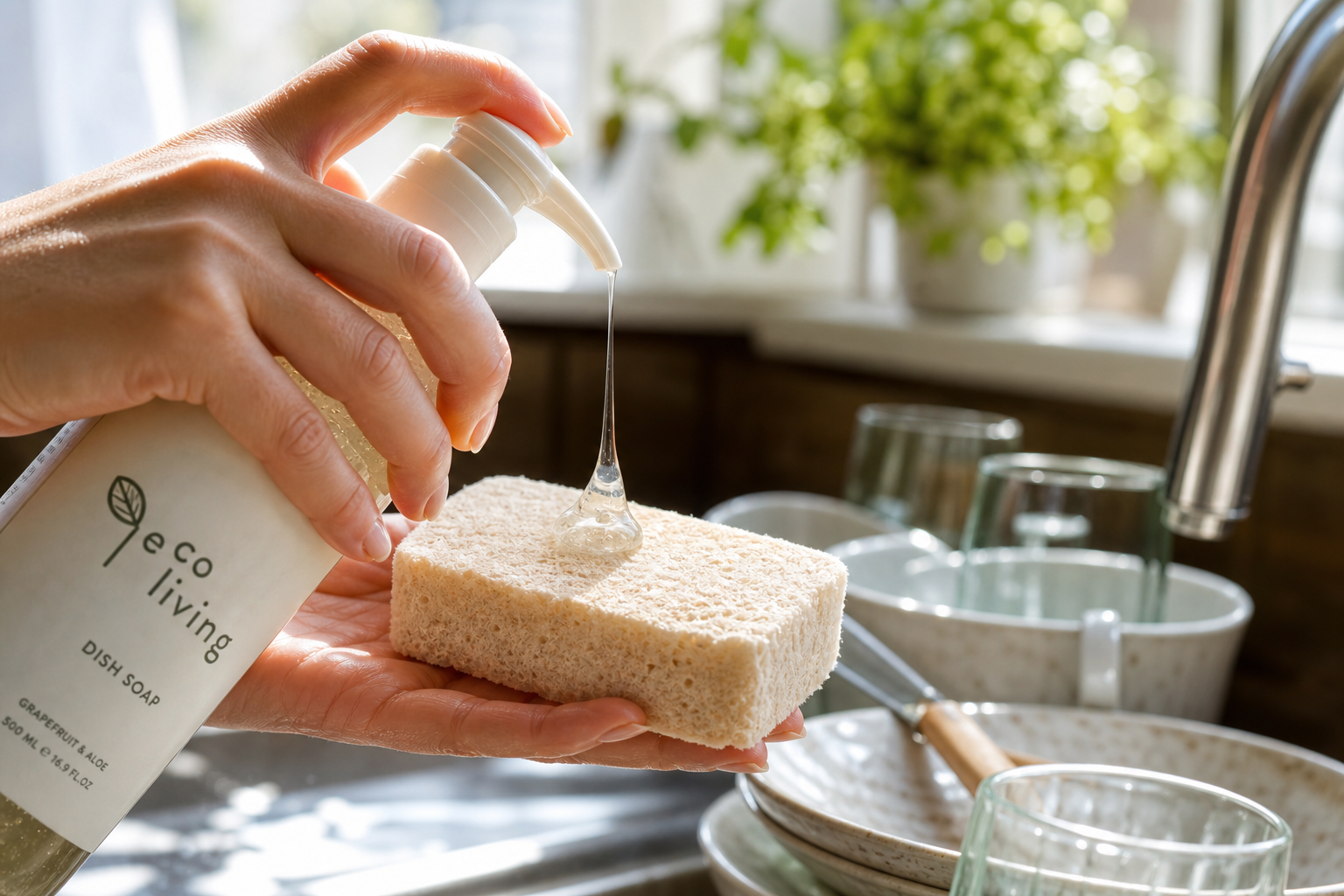
One more thing before you decide: even the cleanest dish soap leaves residue if you use too much. One to two pumps handles a full sink. More soap just means more rinsing and a shorter bottle — not cleaner dishes.
Now that you have your pick, here’s the one label detail that separates a genuinely safe formula from a cleverly marketed one.
Why EWG Verified Is the Only Dish Soap Label Worth Trusting First
You’ve seen dozens of eco claims on cleaning products — here’s the one standard that actually requires a brand to prove it, not just say it.
EWG Verified means the Environmental Working Group has reviewed every single ingredient — including inactive ones — against their strictest safety criteria. No restricted chemicals. No hidden fragrance. Full concentration transparency. And brands can’t swap in cheaper ingredients after earning the logo without losing it — there’s ongoing review built in.
Additionally, EWG Verified screens out over 2,000 hazardous substances before a product qualifies. For something that touches your food surfaces every single day, that’s the baseline — not a bonus.
“I used to spend 20 minutes reading ingredient lists at the store. Now I just look for the EWG Verified logo and I’m done in three seconds.”
That said, EWG Verified isn’t the only marker of a safe product — MADE SAFE and Leaping Bunny both carry real weight. But if you’re choosing one filter to start with, this is it.
One swap is a small thing. But it’s also the kind of small thing that adds up — for your kitchen, your family, and the water that leaves your drain every night.
Frequently Asked Questions About Non-Toxic Dish Soap
A non-toxic dish soap skips synthetic fragrance, SLS, SLES, artificial dyes, and formaldehyde-releasing preservatives like DMDM Hydantoin — and uses plant- or mineral-derived surfactants instead. The fastest way to verify one is to look for EWG Verified or MADE SAFE certification. Both screen thousands of harmful substances so you don’t have to decode every ingredient yourself.
SLS is a foaming agent linked to skin and eye irritation with regular exposure. SLES — its close relative — may be contaminated with 1,4-dioxane during the manufacturing process (at the concentrations typically found in household products). Neither ingredient is necessary for effective cleaning. Switch to a plant-based surfactant formula and you’ll get the same grease-cutting power without the trade-off.
Yes — and every pick on this list has proven it in a real kitchen, not just a lab. Branch Basics, Attitude, and ECOS all use plant-derived surfactants that break down grease as effectively as conventional formulas. The key is warm water and giving the soap a few seconds to work. You’ll get the same result — without leaving synthetic residue on the plates your food touches.
“Natural” is an unregulated marketing term — any brand can print it on a bottle with zero verification or requirements. Non-toxic, when backed by a certification like EWG Verified or MADE SAFE, means a third party has reviewed the formula against known harmful substances. When you see “natural” without a recognized certification logo, treat it as a claim to investigate, not a fact to trust.
Most hand-washing dish soaps create too much foam for dishwashers and can cause overflow or damage over time. For dishwashers, you need a specifically formulated tablet or pod. Both Blueland and Branch Basics make EWG Verified dishwasher-specific products that work in standard and high-efficiency machines — check each brand’s site for their dishwasher line directly.
One to two pumps handles a full sink of dishes. Plant-based surfactants don’t need to lather heavily to clean — that expectation is a leftover from years of SLS-heavy soaps. Start with one pump. Add a second only if you’re scrubbing a roasting pan or cast iron. Using less also makes your bottle last significantly longer, which cuts your per-wash cost down noticeably.