This post contains affiliate links. If you purchase through our links, we may earn a small commission at no extra cost to you.
The Best Eco Friendly Diapers for Your Baby’s Skin
There is no ingredient list on a box of conventional diapers. Not on the front, not on the back, not anywhere. U.S. law does not require diaper brands to disclose what touches your baby’s skin through 2,500 to 3,000 changes in the first year of life alone.
That means synthetic fragrance compounds, chlorine-bleached pulp, dioxin byproducts, lotion coatings, and adhesive chemistry — all unlabeled, all in contact with a newborn 24 hours a day. If that makes you want to look harder at what’s actually in a diaper, you’re asking exactly the right question.
By the end of this guide, you’ll know which ingredients to avoid, which certifications actually verify safety, which brands perform best for sensitive skin, and how eco friendly diapers honestly compare to cloth. No guilt, no overwhelm, no vague “plant-based” promises.
Why Conventional Diapers Deserve More Scrutiny Than They Get
Most parents never question their diapers — but this is one of the least transparent product categories in baby care. Diapers occupy a regulatory gray zone: not a cosmetic, not a medical device, and subject to almost no labeling requirements in the U.S.
A conventional diaper brand can include synthetic fragrance, chlorine-bleached pulp, lotion coatings, and colorant dyes — and disclose none of them on the box. For a product with 24-hour skin contact on your newborn’s most sensitive area, that lack of transparency is exactly why parents start researching non-toxic diapers.
Chlorine Bleaching and Dioxin: What the FDA Actually Says
The wood pulp core in most conventional diapers uses elemental chlorine bleaching — a process that produces dioxin and furan byproducts as processing residues. Dioxins are classified by the EPA as likely human carcinogens. They are persistent organic pollutants that accumulate in body tissue over time.
The FDA acknowledges that trace dioxin levels in conventional diapers are detectable. Its position: a single exposure falls below thresholds of concern. That position does not address cumulative exposure across 2,500+ changes per year.
Chlorine-free diapers use one of two methods: Elemental Chlorine Free (ECF) bleaching, which reduces but doesn’t eliminate dioxin production, or Totally Chlorine Free (TCF) bleaching, which uses oxygen, ozone, or hydrogen peroxide — and produces no dioxin byproducts at all. TCF is the gold standard. Don’t accept “chlorine-free” as an undifferentiated claim.
Synthetic Fragrance: The Most Common Diaper Rash Trigger
Synthetic fragrance triggers more cases of contact dermatitis and diaper rash in infants than almost any other ingredient. “Fragrance” as a label declaration can legally represent hundreds of individual chemical compounds. Some carry classifications as allergens or endocrine disruptors, for individuals with sensitivity to these compounds.
Most pediatric dermatologists recommend fragrance-free diapers as the baseline for any infant. Fragrance-free should be your minimum requirement — not a premium feature. And yet it’s absent from many conventional diaper brands.
Lotion Coatings: Marketed as Gentle, But Worth Scrutinizing
Many conventional diapers apply aloe or lotion coatings to the inner liner — marketed as skin-conditioning. However, these coatings add chemical compounds to the highest skin-contact surface without disclosing the specific formulation. They can interact with diaper cream and may contribute to rash in sensitive infants, at the concentration levels applied to the liner surface.
A genuinely chemical free diaper for sensitive baby skin should have no lotion or aloe coating, no synthetic fragrance, and a liner certified by OEKO-TEX or MADE SAFE for restricted substances.
“Fragrance-free should be your minimum requirement — not a premium feature. And yet it’s absent from many conventional diaper brands.”
The takeaway: conventional diapers aren’t labeled, regulated, or designed for ingredient transparency. The next section breaks down exactly what’s inside them — layer by layer.
What’s Actually Inside a Conventional Disposable Diaper, Layer by Layer
Understanding the layers in a conventional diaper makes the differences between conventional and eco options concrete — not abstract. Here’s what each layer is, what it’s made from, and where the meaningful upgrades are.
The Absorbent Core: Where Eco Brands Are More Similar Than You’d Think
Every disposable diaper — conventional and eco — uses superabsorbent polymer (SAP), a sodium polyacrylate gel derived from petroleum. SAP absorbs liquid at many times its own weight. No eco diaper brand has replaced SAP with a plant-derived equivalent that matches its absorbency at comparable thickness.
The SAP content is essentially the same across conventional and eco brands. The meaningful differences live in the wood pulp quality, bleaching process, outer cover materials, and liner chemistry. Any brand implying its eco credentials come from a “plant-based absorbent core” without disclosing SAP content deserves skepticism.
The Outer Cover: Petroleum Plastic vs. Bio-Based Film
The waterproof outer cover in conventional diapers is polyethylene film — a petroleum-derived plastic that doesn’t biodegrade or compost under standard conditions. Eco friendly disposable diapers use plant-based polyethylene (bio-PE, derived from sugarcane ethanol) or PLA (polylactic acid, corn-derived) films instead.
These bio-based alternatives carry a lower carbon footprint. However, they still require industrial composting conditions to biodegrade meaningfully — which is why the biodegradable vs. compostable distinction matters so much in this category.
The Inner Liner: The Layer That Matters Most for Your Baby’s Skin
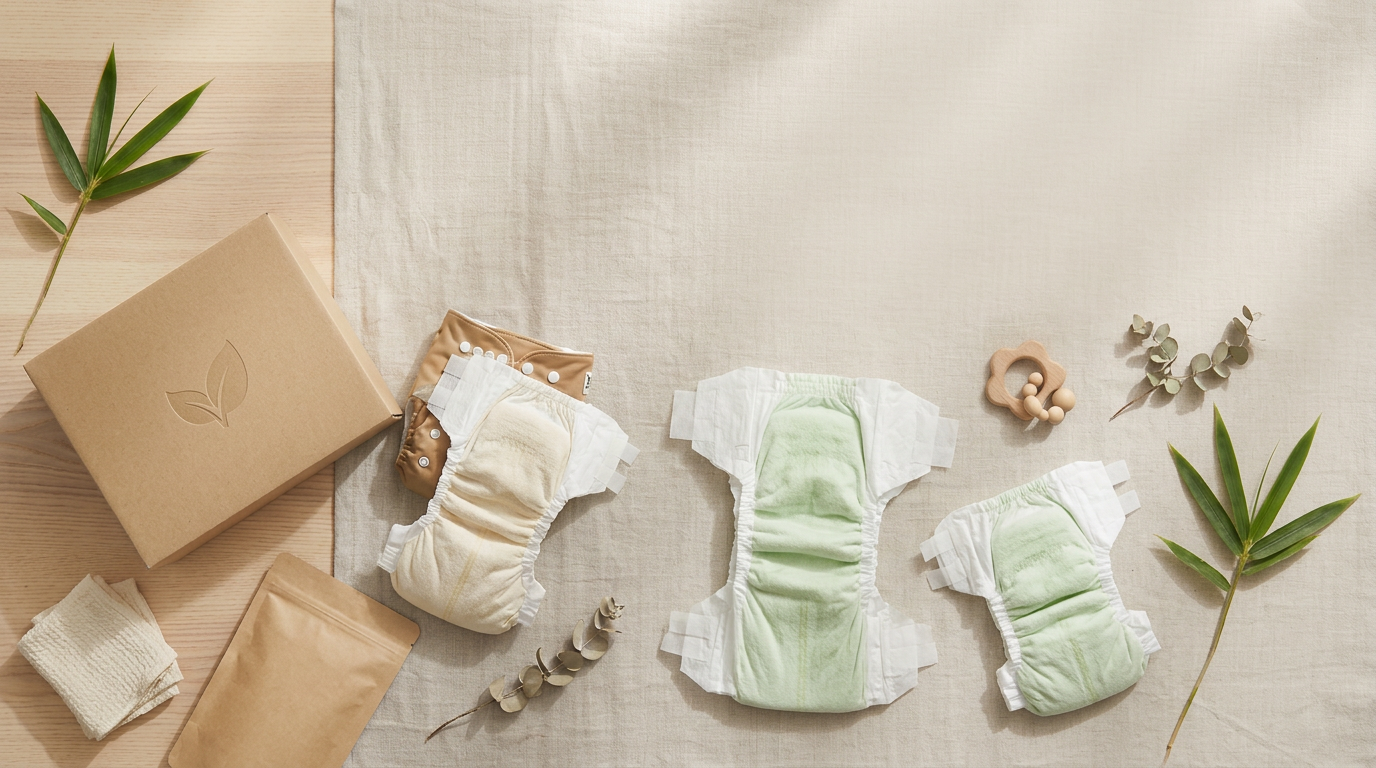
The inner liner touches your baby’s skin directly — and it’s where the most meaningful material difference lives. Conventional diapers use polypropylene nonwoven fabric — the same petroleum-derived synthetic fiber found in surgical masks and disposable wipes.
Eco alternatives use bamboo fiber nonwoven, organic cotton nonwoven, or TCF-bleached wood pulp liners. These natural fiber alternatives are softer, more breathable, and free from the chemical residues that can persist in synthetic nonwoven processing. For babies with sensitive skin or eczema, the inner liner upgrade is the single most important material change you can make.
Conventional: polypropylene nonwoven (petroleum-derived)
Eco: bamboo viscose, organic cotton, or TCF-bleached wood pulp
Both: SAP (sodium polyacrylate) + wood pulp
Eco upgrade: TCF-bleached pulp instead of chlorine-bleached
Conventional: polyethylene film (petroleum plastic)
Eco: bio-PE (sugarcane) or PLA (corn-derived) film
Conventional: synthetic fragrance and aloe/lotion coatings common
Eco: fragrance-free, lotion-free in certified options
Bottom line on materials: the SAP core is the same everywhere — your upgrade choices are liner, bleaching method, and fragrance. The next section shows which certifications actually verify those choices.
Eco Diaper Certifications That Verify Safety vs. Labels That Mean Nothing
This is the part most guides skip — and it determines whether your switch actually delivers what you’re hoping for. “Plant-based,” “natural,” “eco,” “gentle,” and “dermatologist tested” are completely unregulated terms. Any brand can apply them to any diaper. These are the labels worth looking for specifically on organic baby diapers and eco disposables.
“Biodegradable” on a diaper almost never means what you think it means. Most biodegradable diapers require industrial composting conditions — specific temperature, humidity, and aeration — to biodegrade at the rate the packaging claims. In a standard landfill, where 95% of all disposable diapers end up, the anaerobic (oxygen-free) environment means most “biodegradable” eco diapers degrade at roughly the same rate as conventional ones — sometimes hundreds of years. True compostability currently requires access to an industrial composting service. Dyper’s REDYPER pickup service is the only mainstream option that closes this loop, in participating cities. “Biodegradable” is only a meaningful claim when paired with a realistic disposal pathway.
The takeaway: MADE SAFE and OEKO-TEX Standard 100 most directly verify what touches your baby’s skin. Everything else is secondary — or marketing copy.
Eco Disposables vs. Cloth Diapers: The Honest, Non-Judgmental Breakdown
The cloth vs. disposable debate generates more heat than data. Here’s what the evidence actually shows — and which system fits which household reality.
Environmental Impact: The Key Variable Is Your Washing Routine
Full lifecycle analyses consistently show that cloth diapers have a lower environmental impact than disposables — including eco friendly ones — when washed in full loads and line-dried or dried on a warm cycle. The gap narrows significantly when cloth involves daily hot washes on partial loads with gas-heated tumble drying.
The honest summary: cloth diapering beats eco disposables environmentally when you use energy-efficient washing practices. Switching from conventional disposables to eco friendly disposables still makes a real, meaningful reduction — it requires no infrastructure change at all.
Skin Safety: Cloth Wins by Default — With One Real Tradeoff
Organic cotton or natural fiber cloth diapers contain no SAP, no bleached pulp, no synthetic liner, and no adhesive chemistry. Babies with chronic diaper rash, eczema, or chemical sensitivity often see dramatic improvement after switching to cloth.
The tradeoff: cloth requires more frequent changes — every 1.5–2 hours for newborns versus 3–4 hours for an absorbent eco disposable. Additionally, zinc oxide-based diaper creams can coat cloth fibers and reduce absorbency over time, for the cloth insert materials used in most systems. Cloth-safe cream formulations use different chemistry.
Sound like more than you can take on right now? The hybrid system below solves most of this.
Which System Fits Your Household
-
Full-time cloth works best for:
Households with a dedicated laundry routine, a caregiver home most of the day, and a daycare that accepts cloth. Check your provider’s policy before committing — many do not allow cloth. -
Hybrid systems (GroVia, bumGenius Flip) work well for:
Households wanting cloth benefits at home with a certified disposable insert for daycare, travel, and overnight — two systems in one shell. -
Eco friendly disposables work best for:
Full-time daycare users, frequent travelers, single-parent households with genuine laundry constraints, and families transitioning from conventional who want to reduce chemical exposure without a full system change. -
No system is universally superior:
Cloth part-time plus a certified non-toxic disposable for the rest is a genuinely positive choice. The perfect should not be the enemy of the meaningfully better.
GroVia’s hybrid one-size shell with snap-in inserts is the best starting point if you’re curious but not ready to commit. The reusable shell holds either a cloth insert or a disposable/compostable soaker pad — cloth at home, disposable insert at daycare, no managing two separate systems. Shells last from approximately 10 lbs through potty training. A starter kit of 6 shells and 12 inserts covers a basic home rotation.
The takeaway: cloth wins on skin safety and long-term environmental impact — but eco friendly disposables represent a real, meaningful upgrade that fits more households’ actual daily lives.
The Best Eco Friendly Diaper Brands: Honest Comparisons by Use Case
These are the most consistently recommended brands in the best biodegradable diapers and non-toxic disposable category — chosen for material safety credentials, certification depth, honest absorbency performance, and real price-per-diaper value.
Best for Sensitive Newborn Skin: Coterie — MADE SAFE Certified, Performance-First
Coterie is the most thoroughly certified disposable diaper available today. It carries MADE SAFE certification — the most demanding safety standard in the entire category. The diaper is fragrance-free, lotion-free, chlorine-free, and free from latex, PVC, and optical brighteners, with a soft plant-based inner liner.
Absorbency and leak protection consistently rank among the best in the category. Coterie performs as a premium diaper first — the safety certification reflects genuine material choices, not a marketing layer applied to a conventional core.
The honest caveat: at approximately $0.40–$0.55 per diaper, Coterie is the most expensive option here. For babies with chronic skin irritation, eczema, or persistent rash, the MADE SAFE certification makes it the most defensible premium in the category.
→ Shop Coterie (MADE SAFE Certified — Best for Sensitive Skin)
Best Plant-Based Disposable: Dyper — USDA Biobased Bamboo with a Real Composting Option
Dyper makes diapers from USDA Certified Biobased bamboo viscose fiber — softer than conventional wood pulp nonwoven and produced without chlorine bleaching. Their REDYPER service picks up used diapers for industrial composting in select cities — the only mainstream brand offering a genuine end-of-life composting pathway.
Absorbency performance is strong. The bamboo inner liner earns consistently strong reviews for sensitive skin applications. Price runs approximately $0.32–$0.45 per diaper on subscription — a meaningful step below Coterie with solid plant-based credentials.
→ Shop Dyper (USDA Biobased Bamboo — REDYPER Composting Available)
Best Accessible Eco Disposable: The Honest Company — Certified and Stocked Everywhere
The Honest Company diapers are the most widely available certified eco friendly disposable — sold at Target, Walmart, Amazon, and most major retailers. They use chlorine-free processing, fragrance-free construction, and plant-based inner liner materials at $0.25–$0.35 per diaper.
Their certification stack is less rigorous than Coterie’s MADE SAFE. That said, they represent a meaningful improvement over conventional diapers on every material dimension at an accessible price. Overnight performance is adequate — not the strongest for heavy wetters.
→ Shop The Honest Company (Chlorine-Free — Best Accessible Eco Option)
The Honest Company is the right everyday choice. Save Coterie for newborns with known skin sensitivity or a baby currently dealing with persistent rash — that’s where the MADE SAFE certification earns its price premium.
Best Budget Bamboo Diaper: Andy Pandy — OEKO-TEX Certified at an Accessible Price
Andy Pandy diapers use bamboo viscose fiber and carry OEKO-TEX Standard 100 certification. They are free from chlorine, fragrance, latex, alcohol, PVC, and TBT (tributyltin — a toxic organotin compound used as a biocide in some conventional diaper processing). TCF bleaching is used throughout the formula.
At approximately $0.28–$0.38 per diaper, Andy Pandy is the most affordable bamboo fiber option with a meaningful certification. Absorbency works well for daytime use. The bamboo inner liner earns consistently strong reviews for sensitive skin.
→ Shop Andy Pandy (Bamboo, OEKO-TEX Certified — Best Budget Bamboo)
Best Hybrid System: GroVia — Cloth at Home, Disposable Insert at Daycare
GroVia’s hybrid one-size shell with interchangeable inserts is the most recommended entry point into cloth diapering for flexible households. The reusable PUL shells use snap closures (no Velcro wear). Cloth inserts are certified organic cotton. Disposable inserts are chlorine-free and fragrance-free for daycare and travel days.
A full rotation of 6–8 shells and 12–16 inserts costs approximately $200–$300 upfront. That covers diapering from around 10 lbs through potty training — significant long-term savings compared to two years of premium eco disposables.
→ Shop GroVia Hybrid System (Cloth + Disposable Insert Flexibility)
Best Full Cloth System: Thirsties and bumGenius — Built for the Full Diapering Period
For households committed to full-time cloth diapering, Thirsties and bumGenius are the two most consistently recommended all-in-one brands. Both use certified organic cotton inner layers, durable PUL covers, and snap or hook-and-loop closures designed to last the full diapering period.
bumGenius Freetime all-in-ones are the most popular single-diaper cloth system — no stuffing required, washes and dries as one unit. Thirsties all-in-two systems offer a more flexible two-piece snap-in design. A full cloth stash of 24–30 diapers runs approximately $350–$600 — covering the full period and potentially a second child with proper care.
→ Shop Thirsties and bumGenius All-in-One Cloth Diapers
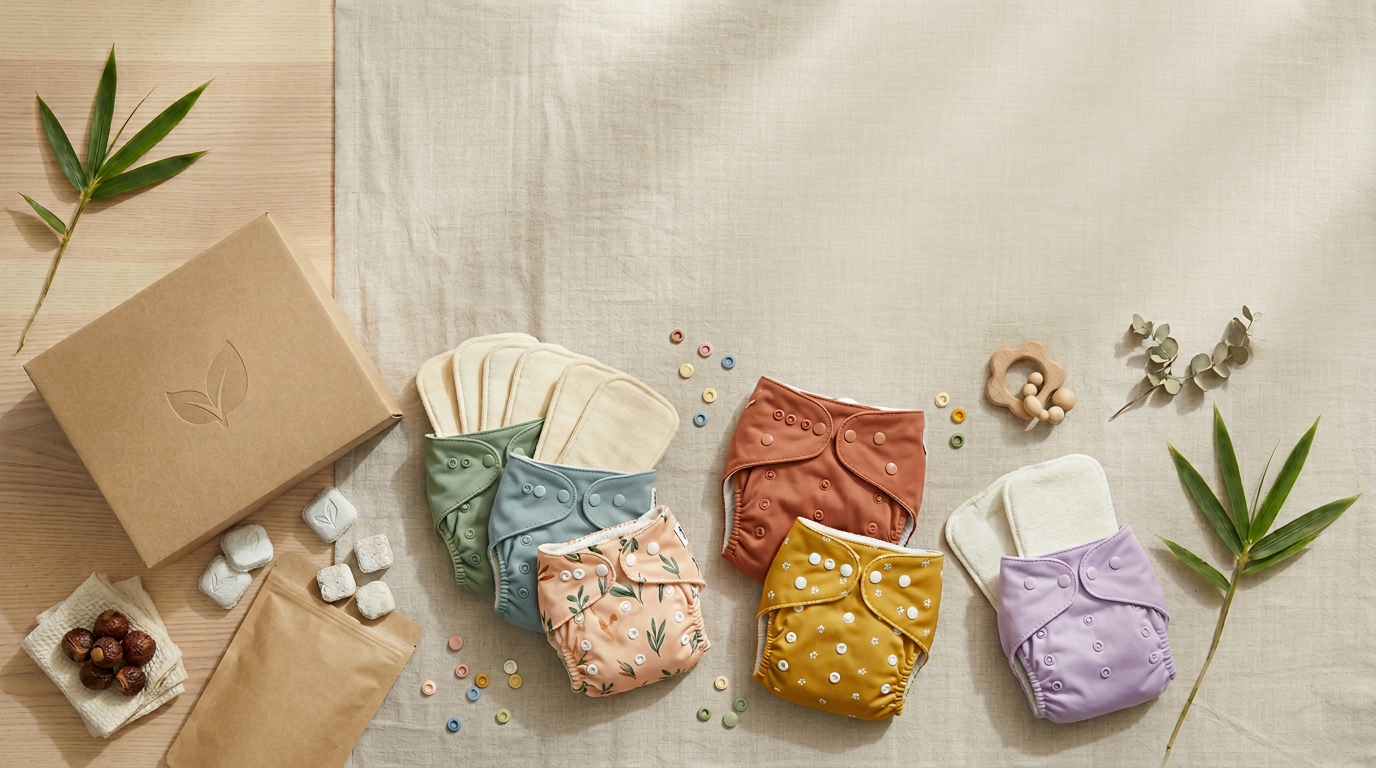
“A full cloth stash covers the entire diapering period — and potentially a second child. The upfront cost looks big until you compare it to two years of premium eco disposables.”
Eco Friendly Diaper Brand Comparison: All Six Options at a Glance
Here’s how all six options stack up across the factors that matter most — certification depth, material safety, price per diaper, and best use case.
| Brand | Key Certification | Inner Liner | Bleaching Method | Price / Diaper | Best For |
|---|---|---|---|---|---|
| Coterie | MADE SAFE | Plant-based nonwoven | Chlorine-free | $0.40–$0.55 | Sensitive skin, newborns, eczema |
| Dyper | USDA Biobased | Bamboo viscose | TCF | $0.32–$0.45 | Plant-based priority, composting access |
| The Honest Company | Chlorine-free (brand-reported) | Plant-based liner | Chlorine-free | $0.25–$0.35 | Transitioning from conventional; wide retail access |
| Andy Pandy | OEKO-TEX Standard 100 | Bamboo viscose | TCF | $0.28–$0.38 | Budget bamboo, sensitive skin |
| GroVia Hybrid | GOTS Organic Cotton | Organic cotton insert | N/A (cloth) | $200–$300 (full kit) | Hybrid cloth/disposable flexibility |
| Thirsties / bumGenius | GOTS Organic Cotton | Certified organic cotton | N/A (cloth) | $350–$600 (full stash) | Full-time cloth diapering |
Eco Friendly Diapers — Frequently Asked Questions
An eco friendly diaper uses plant-derived or natural fiber materials instead of petroleum-based synthetics, avoids chlorine bleaching (preferably TCF methods), contains no synthetic fragrance or lotion coatings, and carries third-party certification such as MADE SAFE or OEKO-TEX Standard 100. Better packaging — recycled cardboard over plastic shrink wrap — also matters. Start your evaluation by checking the bleaching method and inner liner material before reading anything else on the label.
For most babies, yes — especially for infants with sensitive skin, eczema, or chronic diaper rash. Removing synthetic fragrance, chlorine-bleached pulp, and lotion coatings eliminates the three most common chemical irritants in conventional diapers. Babies with persistent rash that hasn’t responded to diaper cream alone often see improvement after switching to a fragrance-free, chlorine-free option with a natural fiber liner, at the contact levels involved in normal diaper wear. Switch to a certified fragrance-free eco diaper and reassess after two to three weeks.
Not in the premium tier. Coterie and Dyper consistently receive leak protection reviews that match or exceed conventional diaper brands. The Honest Company and Andy Pandy perform reliably for daytime use; overnight performance for heavy wetters is where budget eco options sometimes fall short. The absorbent core in all disposable diapers — eco and conventional — uses the same SAP technology, so absorbency capacity is broadly comparable. Try your chosen brand for a week and size up if leaks occur at the back waistband.
Only under specific conditions that most households cannot access. Most biodegradable diapers require industrial composting — controlled temperature, humidity, and aeration — to biodegrade at the rate the marketing claims. In a standard landfill, which receives 95% of all disposable diapers, anaerobic conditions mean most biodegradable diapers degrade at roughly the same rate as conventional ones. The only mainstream option with a real composting pathway is Dyper’s REDYPER pickup service, in select U.S. cities. Check Dyper’s website for current service areas before purchasing if composting is your primary goal.
Coterie is the most safety-verified disposable diaper currently available — MADE SAFE certified, fragrance-free, lotion-free, chlorine-free, and free from PVC, latex, and optical brighteners. For newborns with no known skin sensitivity, Andy Pandy’s OEKO-TEX certified bamboo diaper offers a meaningful safety upgrade over conventional diapers at a more accessible price. For newborns with eczema or a family history of chemical sensitivity, Coterie’s MADE SAFE certification is the most defensible choice — check their current newborn sizing and subscription options before the baby arrives.
The gap is smaller than most parents expect. Andy Pandy and The Honest Company start at $0.25–$0.35 per diaper — comparable to mid-range conventional brands. Coterie at $0.40–$0.55 sits at the premium end. Over one year at 2,500 changes, switching from a $0.20 conventional diaper to a $0.30 eco option adds roughly $250 annually. Cloth diapering costs $200–$600 upfront and near-zero per change thereafter. Use the price-per-diaper figures in the table above to build your own comparison against your current brand.
For eco disposables, yes — any diaper cream works without restriction. For cloth diapers, zinc oxide-based creams (the most common rash treatment) coat cloth fibers and reduce absorbency over time, for the cloth insert materials used in most systems. Cloth-safe diaper creams use beeswax, shea butter, or coconut oil bases that rinse cleanly from cloth fibers. If you use a hybrid system, apply zinc oxide cream only on days with a disposable insert, and switch to a cloth-safe cream on cloth days to protect the inserts.
One diaper change is a small thing. But multiply it by 2,500 in the first year alone — every one of them on your baby’s most sensitive skin — and the material choices start to matter. You now have the ingredient knowledge, the certification framework, and the brand-by-brand breakdown to make one clear decision today. Pick the option that fits your budget and your household, order a small pack first, and run it for two weeks. The difference will speak for itself.
Shop All Recommended Eco Friendly Diapers
Every brand covered in this guide — chosen for certified safety credentials, honest absorbency performance, and real value per diaper.
→ Shop Coterie (MADE SAFE Certified — Best for Sensitive Skin & Newborns)
→ Shop Dyper (USDA Biobased Bamboo — REDYPER Composting Available)
→ Shop The Honest Company (Chlorine-Free — Best Accessible Eco Option)
→ Shop Andy Pandy (Bamboo, OEKO-TEX Certified — Best Budget Bamboo)
→ Shop GroVia Hybrid System (Cloth + Disposable Insert Flexibility)
→ Shop Thirsties & bumGenius All-in-One Cloth Diapers (Full Cloth System)