This post contains affiliate links. If you purchase through our links, we may earn a small commission at no extra cost to you.
The Best Eco Friendly Water Bottle for Every Use
Your “BPA-free” reusable bottle probably still contains bisphenols. When manufacturers pulled BPA under consumer pressure, most replaced it with bisphenol-S or bisphenol-F — structurally similar compounds with comparable estrogenic activity in early research, for individuals with sensitivity to these compounds. Neither appears on a “BPA-free” label.
Then there’s the powder coat on your stainless steel bottle. Independent lab testing of popular brands has detected PFAS compounds — the “forever chemicals” linked to thyroid disruption and immune effects at high-exposure levels — in exterior coatings. On the outside of your water bottle.
Choosing a genuinely eco friendly water bottle in 2026 means asking harder questions than “is it reusable?” By the end of this guide, you’ll know exactly which materials to choose and avoid, which certifications actually verify safety, which PFAS risks are real versus overstated, and which brand fits your specific use case — with the documented credentials to back it up.
“BPA-Free” Is One of the Most Misleading Labels in Consumer Products
This matters directly to you — because if you switched to a BPA-free bottle thinking you solved the bisphenol problem, you may not have. Bisphenol-A came under regulatory pressure in the late 2000s. Manufacturers removed it from most reusable bottles and containers. Then they replaced it with bisphenol-S (BPS) and bisphenol-F (BPF) — compounds not covered by BPA-free regulations, and with limited independent safety testing at the time.
Research published in Environmental Health Perspectives found that BPS and BPF exhibit estrogenic activity in cell studies and animal models comparable to BPA, at the concentrations studied. The FDA has not restricted BPS or BPF in food-contact materials. A bottle labeled “BPA-free” may still contain BPS or BPF. The label tells you nothing about which bisphenol substitute the manufacturer used.
The “Regrettable Substitution” Pattern — and Why It Keeps Happening
Toxicologists call this “regrettable substitution” — removing one chemical of concern and replacing it with a structurally similar compound without adequate independent safety testing. The pattern repeats: PFOA replaced by PFOS, then by GenX; phthalate plasticizers replaced by related alternatives.
For water bottles, the practical implication is clear: “BPA-free” plastic is not a verified non-toxic credential. It is a claim of absence for one compound in a chemical family with multiple members of comparable concern.
The only verified non-toxic water-contact materials are those with no plastic in the water pathway at all. Food-grade stainless steel, borosilicate glass, and food-grade silicone carry the strongest safety evidence for water contact across the temperature ranges you encounter in daily use.
Eastman’s Tritan plastic — marketed as BPA-free and used in many premium bottles — was the subject of independent research in Environmental Health Perspectives (2011) that detected estrogenic activity in Tritan extracts under stress conditions including UV exposure and dishwasher heat. Eastman disputed the methodology and funded counter-studies. The picture remains contested.
What is not contested: Tritan contains no BPA, and Eastman has published compositional data showing its monomers have low estrogenic activity in their own testing. For buyers who want verified zero bisphenol exposure, stainless steel and glass eliminate the question entirely. For buyers comfortable with Tritan at the current evidence level, it remains the lightest and most drop-resistant option in the BPA-free plastic category.
The takeaway: “BPA-free” is a marketing minimum, not a safety credential. The next section shows what’s actually inside the bottles you’ve been using — layer by layer.
What Your Conventional Plastic Water Bottle Is Actually Made Of
Understanding the specific materials in conventional plastic bottles makes the upgrade to stainless or glass feel concrete — not abstract. Here’s what each plastic type means for you.
Polycarbonate (#7 Plastic): Replace This Immediately
Polycarbonate is the original BPA-containing hard plastic used in early Nalgene bottles and many reusable containers. BPA is not an additive here — it’s a structural building block of the plastic. It leaches into water under heat: dishwashers, hot cars, boiling water.
Polycarbonate is now rare in consumer bottles due to regulatory restrictions, but it persists in some sporting goods and outdoor equipment. Look for recycling code #7 on the bottom. Replace any #7 polycarbonate bottle immediately with food-grade stainless or borosilicate glass.
Polypropylene (#5 Plastic): Generally Acceptable — With a Caveat
Polypropylene is the safest widely-used plastic for beverage contact. It contains no BPA, has low chemical migration at ambient temperatures, and stays heat-stable up to approximately 120°C (248°F). Most lid components, straws, and bite valves on stainless steel bottles use polypropylene or food-grade silicone.
However, the concern with polypropylene is not acute toxicity — it’s microplastic shedding. Research published in 2024 in Nature Medicine found bottled water contains significantly more microplastic particles than earlier measurements showed. The health implications of microplastic ingestion remain under active study. The precautionary case for stainless and glass interiors — which shed no microplastics — grows stronger as this research develops.
Aluminum with Epoxy Lining: The Hidden Plastic Interior Most People Miss
This is the most misunderstood material in the reusable bottle category — and the most important one to understand. Many aluminum bottles, including some marketed as eco friendly, use an interior epoxy lining to prevent aluminum from reacting with beverages.
Epoxy linings have historically been a major source of BPA exposure in canned foods and beverage liners. Most brands now use BPA-free epoxy — but the same bisphenol-substitute concerns apply. The interior of an epoxy-lined aluminum bottle is, functionally, a thin plastic film. A non toxic water bottle made from aluminum is only genuinely non-toxic if it carries no interior lining at all — acceptable for plain water only, not acidic or carbonated beverages.
For this reason, most serious non-toxic bottle recommendations focus on food-grade stainless steel. Stainless requires no interior lining to be safe for beverage contact.
“The interior of an epoxy-lined aluminum bottle is, functionally, a thin plastic film — and ‘BPA-free epoxy’ carries the same bisphenol-substitute concerns as BPA-free plastic.”
The takeaway: the plastic type in your bottle determines both the chemical exposure and the microplastic risk. The next section maps out every material option — so you can see exactly what to choose instead.
Every Water Bottle Material Compared: Safety, Performance, and Best Use
Here is the complete material comparison for eco friendly water bottle selection. Green cards = recommended. Orange cards = use with caution or avoid.
Safety: Excellent. No leaching at ambient temperatures. Trace nickel migration possible in acidic beverages at levels generally considered safe — relevant for those with a diagnosed nickel allergy.
Insulation: Excellent with double-wall vacuum construction.
Taste: Neutral — no metallic taste in quality 18/8 steel.
Durability: Exceptional — 10–15+ years with proper care.
Microplastics: None from the steel interior.
Best for: Everyday carry, gym, travel, all temperatures.
Safety: The purest water-contact material available. Zero chemical migration, zero taste interference, zero microplastic shedding. Thermal-shock resistant unlike standard soda-lime glass.
Insulation: None in single-wall; double-wall glass construction available.
Taste: The most neutral taste profile of any bottle material.
Durability: Breakable — a protective silicone sleeve is essential.
Best for: Home, desk, commute, low-impact use.
Safety: Good. Food-grade platinum-cured silicone is inert and does not leach detectable compounds into water at use temperatures.
Temperature range: Stable from -40°C to 220°C.
Durability: Long-lasting. Inspect and replace gaskets annually — sustained UV and harsh dishwasher detergents degrade silicone over time.
Best for: Lid, gasket, and straw components in stainless or glass systems.
Safety: Conditional. Most aluminum bottles use an epoxy lining with bisphenol-substitute concerns equal to BPA-free plastic. Unlined aluminum is safe for plain water only — reacts with acidic or carbonated beverages.
Insulation: Single-wall only in most aluminum bottles — no insulation.
Durability: Dents more easily than stainless.
Verdict: Inferior to stainless on safety profile for most uses.
Safety: No BPA — bisphenol substitute safety remains contested (see warning box above).
Insulation: None — plastic has poor thermal performance.
Taste: Mild plastic taste possible, more noticeable as the bottle ages.
Microplastics: Sheds particles with use and washing.
Best for: Kids’ bottles where drop resistance matters most; short-term use where light weight is critical.
Safety: Contains BPA as a structural monomer. Leaches BPA into beverages, especially under heat.
Identification: Recycling code #7 on the bottom; older hard clear plastic Nalgene-style bottles.
Verdict: Replace immediately with food-grade stainless or borosilicate glass — no exceptions.
The takeaway: food-grade stainless steel and borosilicate glass are the only materials with no bisphenol concerns, no microplastic shedding, and no interior coating requirements. Everything else involves a trade-off.
PFAS in Water Bottle Coatings: Where the Real Risk Is — and Where It Isn’t
This is the part most water bottle content avoids entirely. Understanding it means you can make a proportionate, informed decision — instead of ingredient anxiety that swaps one problem for another.
In 2023, independent testing commissioned by the advocacy group Toxic-Free Future detected PFAS compounds in the powder coat finishes of several popular stainless steel brands — including Stanley — at concentrations consistent with intentional use of PFAS chemistry as a coating processing aid. PFAS (per- and polyfluoroalkyl substances — a class of approximately 15,000 synthetic fluorinated chemicals) are persistent contaminants that do not break down in the environment or the body under normal conditions. They are associated with thyroid disruption, immune effects, increased cancer risk, and reproductive harm at sufficient exposure levels. For broader context on PFAS contamination, see EWG’s PFAS resources.
Here’s the part that actually matters for your daily use — and where the risk is lower than the headlines suggest.
Where PFAS Risk Is Real in Water Bottles
-
Powder coat on lid and rim areas:
If PFAS-containing powder coat covers the lid, rim, or any surface contacting your lips or water, the exposure pathway is direct. Most responsible brands apply powder coat to the exterior body only — but this is not universal. -
Lid gaskets from unspecified materials:
Some lid gaskets use rubber or plastic compounds with undisclosed chemistry. Food-grade platinum-cured silicone gaskets are the verified non-PFAS alternative. -
Interior coatings on lined stainless bottles:
A small number of stainless bottles use an interior coating for flavor or non-stick properties. Avoid these entirely. Uncoated 18/8 or 18/10 stainless steel is safe for water contact without any interior coating.
Where PFAS Risk Is Lower in Stainless Bottles
-
Powder coat on the exterior body only:
The exterior body does not contact water. Exposure comes through hand-skin contact — a substantially lower concern than ingestion through a lid or interior surface. -
Bare stainless steel interior with no coating:
Uncoated 18/8 or 18/10 stainless steel interiors contain no PFAS. This is the established safe standard in food-contact material literature.
Look for three things:
- An explicit brand statement that no PFAS appears in any component — including powder coat, lid, and gasket chemistry
- Third-party testing disclosure. Klean Kanteen and Pura are among the brands that have published comprehensive PFAS-free statements.
- Silicone lid gaskets rather than rubber or unspecified plastic
If a brand’s website does not address PFAS chemistry in their materials or FAQ section in 2026, that absence is itself informative. Brands that have done the testing publicize the results.
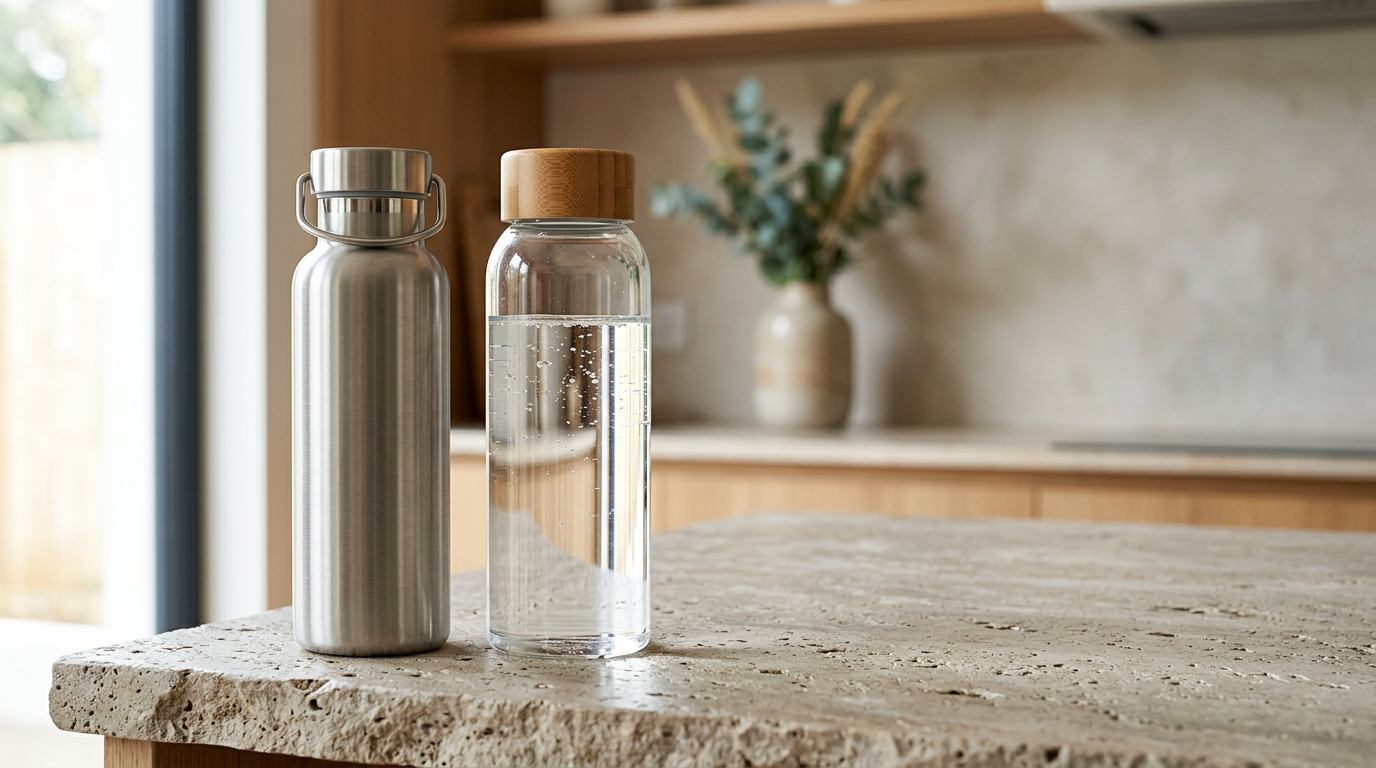
The takeaway: PFAS on the exterior body is a much lower concern than PFAS on the lid or rim. Check for an explicit PFAS-free statement covering all components — not just the bottle body.
Water Bottle Certifications That Verify Safety vs. Labels That Don’t
Certifications on water bottles cover two distinct domains: material safety and brand sustainability. Knowing which is which prevents you from confusing a company’s environmental values with the actual non-toxic credentials of what your water touches.
“NSF/ANSI 51 and an explicit PFAS-free statement covering all components are the two most meaningful things to look for on any bottle label in 2026.”
The Best Eco Friendly Water Bottle Brands, Matched to Your Use Case
These are the most consistently recommended brands in the best reusable water bottles category — selected because their material safety credentials are independently verifiable, and their bottles perform excellently as everyday products first.
Best Overall Non-Toxic Bottle: Klean Kanteen — B Corp, PFAS-Free, Widest Range
Klean Kanteen carries the most comprehensive non-toxic credentials of any brand in this guide. They use food-grade 18/8 stainless steel with no interior coating across their full product line. Their explicit PFAS-free statements cover powder coat and lid materials. They hold B Corp certification and 1% for the Planet membership — credentials that represent verified accountability, not just marketing copy.
Their range is the broadest here: wide mouth and classic sizes from 12 oz to 64 oz, insulated and single-wall options, multiple lid types (loop cap, chug cap, café cap for hot beverages), and a full kids’ line. The food-grade stainless interior has been a consistent brand commitment since 2004. Price range: $22–$55.
→ Shop Klean Kanteen (B Corp, PFAS-Free, All Sizes and Lid Types)
Best Insulated Everyday Carry: Hydro Flask — 24-Hour Cold, Verified Non-Toxic Interior
Hydro Flask’s double-wall vacuum insulation sets the benchmark for temperature retention: 24 hours cold, 12 hours hot in standard use. Their 18/8 stainless steel interior carries no interior coating. Powder coat covers the exterior body only — and in response to the 2023 independent PFAS testing findings, Hydro Flask published a statement confirming no intentionally added PFAS in their powder coat.
Lid components use food-grade polypropylene and silicone. Wide availability at REI, Target, and most major sporting goods retailers makes Hydro Flask the easiest verified non-toxic option to find in person. Price range: $30–$65.
→ Shop Hydro Flask (Best Insulation — 24hr Cold, Verified Non-Toxic Interior)
Choose Klean Kanteen if you want the most thoroughly documented PFAS-free statement and the broadest size range. Choose Hydro Flask if insulation performance and retail availability are your top priorities. Both use verified 18/8 stainless interiors with no interior coating.
Best for Kids and Maximum Material Safety: Pura — No Plastic in the Water Pathway
Pura designs their entire bottle around one standard: no plastic anywhere in the water pathway. Stainless steel body. Certified food-grade silicone lid. Silicone sleeve. Silicone straw. Their PFAS-free claim covers every silicone component, not just the body.
Originally designed as a baby bottle brand, Pura’s complete plastic elimination from all water-contact surfaces makes them the strongest single option for children’s bottles, infants, adults with chemical sensitivity, or any buyer who wants the most conservative possible material profile. Available in infant and toddler configurations as well as adult sizes. Price range: $18–$32.
→ Shop Pura (No Plastic in Water Pathway — Best for Kids and Sensitive Adults)
Best Glass Option: Lifefactory — Zero Chemical Migration, Ideal for Home and Desk
Lifefactory makes borosilicate glass bottles with a protective food-grade silicone sleeve — the purest water-contact material in the category in a format that provides meaningful drop protection. Their silicone sleeves use platinum-cured food-grade silicone. Lids are food-grade polypropylene or stainless steel depending on SKU.
The honest limitation: borosilicate glass with a silicone sleeve is heavier than stainless and not appropriate for gym bags, outdoor use, or high-impact carry. For home hydration, desk use, and low-impact commuting, glass delivers a taste and purity profile no stainless steel bottle matches. Price range: $20–$35.
→ Shop Lifefactory (Borosilicate Glass — Best Taste Purity for Home and Desk)
All Four Recommended Bottles at a Glance
Here’s how the four recommended brands stack up across the factors that matter most for verified non-toxic daily use.
| Brand | Interior Material | PFAS Statement | Lid Material | Price Range | Best For |
|---|---|---|---|---|---|
| Klean Kanteen | 18/8 stainless, no coating | Explicit PFAS-free (all components) | Polypropylene + silicone gasket | $22–$55 | Best overall — widest range, most documentation |
| Hydro Flask | 18/8 stainless, no coating | No intentionally added PFAS in powder coat | Polypropylene + silicone gasket | $30–$65 | Best insulation performance and retail availability |
| Pura | Stainless steel, no coating | PFAS-free all components including silicone | 100% food-grade silicone | $18–$32 | Kids, infants, chemical sensitivity, strictest profile |
| Lifefactory | Borosilicate glass | N/A — glass interior, no coating | PP or stainless; platinum silicone sleeve | $20–$35 | Home, desk, commute — best taste neutrality |
Eco Friendly Water Bottle — Frequently Asked Questions
Food-grade 18/8 or 18/10 stainless steel and borosilicate glass are the two safest materials — both have no plastic in the water pathway, no BPA or bisphenol substitutes, and no microplastic shedding. Stainless steel is the better choice for insulation, durability, and portability. Glass delivers the most neutral taste with zero chemical migration and suits home and desk use best. Start by checking that any stainless bottle you consider carries an explicit PFAS-free statement covering all components, including the lid.
No. BPA-free means the bottle contains no bisphenol-A — but manufacturers commonly replaced BPA with bisphenol-S or bisphenol-F, which exhibit comparable estrogenic activity in early research at the concentrations studied. BPA-free labeling requires no independent verification and does not address PFAS, phthalates, heavy metals, or which bisphenol substitute was used. For verified non-toxic water contact, choose food-grade stainless steel or borosilicate glass and look for NSF/ANSI 51 certification or a MADE SAFE credential.
Yes — with one specific check. Food-grade 18/8 or 18/10 stainless steel interiors with no interior coating are well-established as safe for water contact. The key question is the powder coat and lid materials. Look for an explicit brand statement that no PFAS appears in any component, including the powder coat and lid gasket. Klean Kanteen and Pura publish these statements. Hydro Flask has confirmed no intentionally added PFAS in their powder coat. Choose a brand that answers this question directly, then you can use the bottle with confidence.
Pura is the strongest option for children’s bottles — no plastic in any water-contact position, food-grade silicone lid and straw, explicit PFAS-free certification across all components, and available in infant through toddler configurations. For older kids where drop resistance is the top priority, Klean Kanteen’s kids’ line uses the same verified 18/8 stainless interior and food-grade lid materials as their adult bottles at a smaller size and price point. Check Pura’s sizing guide on their website for the right configuration by age.
Food-grade stainless steel bottles last 10–15 years or longer with basic care — hand washing the lid, avoiding bleach-based cleaners, and replacing silicone gaskets once they show wear. Borosilicate glass bottles last indefinitely unless dropped. Both dramatically outlast plastic bottles, which show wear, scratching, and flavor absorption within 1–3 years. A $35 stainless bottle used for 10 years costs roughly $3.50 per year — less per use than virtually any single-use alternative. Replace lid gaskets annually to maintain airtight performance and minimize silicone degradation.
Hydro Flask published a statement in 2023 confirming their powder coat does not contain intentionally added PFAS, in response to independent testing that found PFAS in several popular stainless bottle brands including Stanley. Their 18/8 stainless steel interior carries no interior coating and does not require PFAS for water contact. Their lid components use food-grade polypropylene and silicone. For the most conservative PFAS-free documentation across every component, Klean Kanteen and Pura publish more comprehensive material disclosure statements. Check each brand’s website for the most current testing disclosures before purchasing.
Check for four things: (1) food-grade 18/8 or 18/10 stainless steel or borosilicate glass interior — not aluminum with epoxy lining; (2) an explicit PFAS-free statement covering all components, not just the body; (3) food-grade silicone or polypropylene lid gaskets — not unspecified rubber; (4) NSF/ANSI 51 certification or MADE SAFE certification if available. “BPA-free” alone does not satisfy any of these four checks. Use this list as your evaluation framework and look up the brand’s material safety FAQ before purchasing.
Now you have the framework — not just the brand names. Check your current bottle for a #7 recycling code on the bottom, look up its powder coat chemistry on the brand’s website, and see if there’s an explicit PFAS-free statement covering every component. If there isn’t, you now know exactly what to replace it with — and which of the four brands above fits your specific situation. That’s the move. Take it.
Shop Every Recommended Eco Friendly Water Bottle
All four brands below use verified non-toxic interior materials — food-grade stainless or borosilicate glass — with documented PFAS-free statements covering lid and gasket components.
→ Shop Klean Kanteen (B Corp, PFAS-Free — Best Overall Non-Toxic)
→ Shop Hydro Flask (Best Insulation — 24hr Cold, Non-Toxic Interior)
→ Shop Pura (No Plastic in Water Pathway — Best for Kids)
→ Shop Lifefactory (Borosilicate Glass — Best Taste Purity for Home and Desk)