
This post contains affiliate links. If you purchase through our links, we may earn a small commission at no extra cost to you.
10 Proven Eco-Friendly Pest Control Solutions That Work
You walk into your kitchen at 7 a.m. and find a line of ants marching straight across the counter. Your hand reaches for the bug spray — then you notice your toddler at the table, your dog sniffing the baseboard, and you stop. There has to be a better way.
There is. Eco-friendly pest control has come a long way from spraying vinegar and hoping for the best. Today’s natural methods are genuinely effective, surprisingly affordable, and — most importantly — safe for the people and animals you love.
By the end of this guide, you’ll know which 7 products actually work, how to use them room by room, and how to mix two DIY sprays that handle most common household infestations in minutes. You’ll also know exactly why conventional sprays create risks most homeowners never consider — and what to use instead.
Why Conventional Pesticides Put Your Family at Risk — and What to Use Instead
Conventional pesticides kill fast. That efficiency comes with real trade-offs that most homeowners don’t think about until something goes wrong. Most synthetic pesticides contain compounds that linger on surfaces, absorb through skin, and accumulate in the body over time.
Children face the highest risk. They spend more time on floors, touch surfaces constantly, and have developing nervous systems — for individuals at this stage of development, even low-level exposure matters more than it would for adults. Pets face similar risks: they groom themselves after walking through treated areas, ingesting whatever residue coats their paws.
Eco-friendly pest control takes a fundamentally different approach. Instead of blasting an area with broad-spectrum chemicals, it uses targeted, lower-risk tools — plant-based insecticides, physical barriers, and biological strategies — to reduce pest populations without creating a toxic environment.
Additionally, non-toxic pest control works best when paired with integrated pest management (IPM) — a strategy that addresses root causes like food sources and entry points rather than just reacting to outbreaks. The table below shows how these two approaches actually compare.
| Feature | Eco-Friendly Pest Control | Conventional Chemical Control |
|---|---|---|
| Safety for kids & pets | High — low-toxicity residues | Lower — warnings required on most labels |
| Indoor air quality | Minimal impact | Can release volatile organic compounds (VOCs — airborne chemical emissions) |
| Environmental impact | Biodegradable, low runoff risk | Can contaminate soil and waterways |
| Long-term effectiveness | Addresses root causes via IPM | Treats symptoms; pests often return |
The takeaway: natural pest control handles the vast majority of household pest problems. The next section covers the three highest-impact methods — starting with the one most people have never tried but should use first.
The 3 Most Effective Eco-Friendly Pest Control Methods for Any Home
These three methods cover the broadest range of common household pests. Use them individually or layer all three for the strongest results.
Diatomaceous Earth: The Mechanical Killer That Never Loses Effectiveness
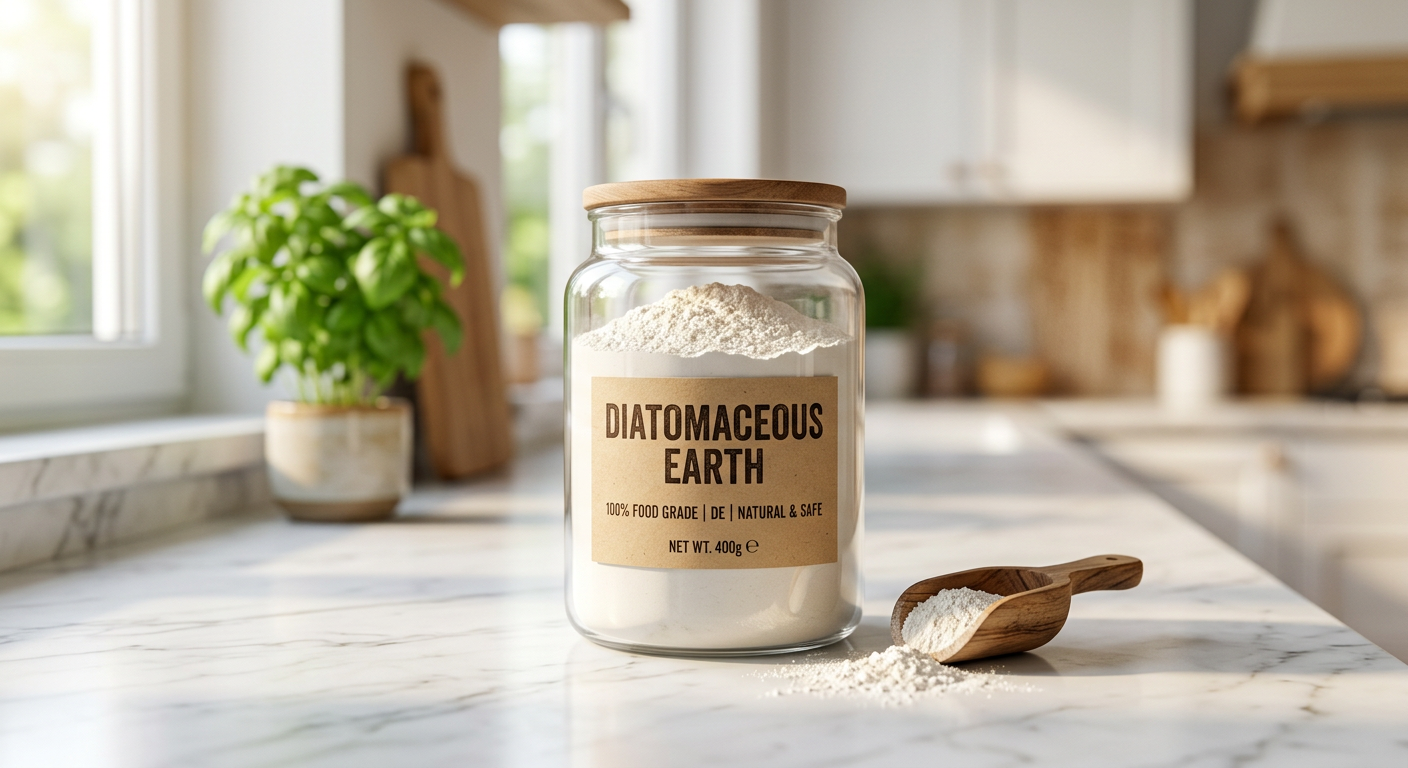
If you add only one tool to your pest-control routine, make it food-grade diatomaceous earth. DE is a fine white powder made from fossilized aquatic organisms. It damages the waxy outer layer of crawling insects, causing them to dehydrate and die — no poison, no chemical residue that harms mammals.
Unlike chemical sprays, insects cannot build resistance to DE because it works mechanically, not chemically. That means it stays effective indefinitely — as long as the powder stays dry.
- Best for: ants, cockroaches, fleas, silverfish, bed bugs, earwigs
- How to apply: Dust a thin layer along baseboards, under appliances, and inside cabinet cracks. Reapply after cleaning or if the area gets wet.
Pool-grade diatomaceous earth undergoes a heat treatment that makes it far more hazardous to inhale. Food-grade DE is the only type safe for use around people and pets. Look for “food-grade” on the label explicitly — and wear a dust mask during application to avoid inhaling any fine particles, for individuals with respiratory sensitivity.
→ Shop Food-Grade Diatomaceous Earth (Safe for Pets and Kids)
Essential Oil Pest Sprays: Fast, Targeted, and Genuinely Effective
Certain essential oils contain compounds that interfere with insect nervous systems — for insects specifically, at the concentrations used in these formulations — and disrupt the pheromone trails they rely on to navigate. You’ve probably walked past these at the store and wondered if they’re just scented water. They’re not.
- Peppermint oil: Repels spiders, ants, and mice. Most effective when applied along entry points and trails.
- Tea tree oil: Deters roaches and silverfish. Apply to cracks and gaps where these insects hide.
- Eucalyptus and citronella: Effective against mosquitoes. Use outdoors near sitting areas and entry doors.
→ Shop Peppermint Oil Pest Spray (Fast Indoor Action Against Ants and Spiders)
Neem Oil: The Best Organic Pest Control for Gardens and Houseplants
Neem oil comes from the seeds of the neem tree. It contains azadirachtin (a naturally occurring compound that disrupts insect hormone systems), preventing reproduction and larval development. It doesn’t just kill — it breaks the pest life cycle. That makes it one of the most effective plant-based insecticides available for garden use.
For anyone building an organic garden, neem oil covers aphids, whiteflies, spider mites, and fungus gnats without harming pollinators when applied correctly — in the early morning or evening when bees are inactive.

→ Shop Neem Oil Concentrate (Organic Garden and Houseplant Pest Control)
“Insects cannot build resistance to diatomaceous earth — because it works mechanically, not chemically. It stays effective indefinitely, as long as the powder stays dry.”
The takeaway: these three methods cover crawling insects, flying pests, and garden infestations. Use all three together and you have a complete natural pest control system with no toxic residue.
The Top 7 Eco-Friendly Pest Control Products Worth Buying
Every product below targets a specific pest problem with verified non-toxic credentials. These are the natural pest control products we recommend across every major household pest category.
One bag handles multiple pest types for months. Safe around pets and kids when applied as a thin dust layer. No resistance build-up — pests cannot adapt to a mechanical kill mechanism.
Great for targeted action against spiders and ants indoors. Works without harsh smell or sticky residue. Reapply every few days along trails for best results.
Disrupts pest reproduction rather than just killing on contact. Covers aphids, whiteflies, spider mites, and fungus gnats. Safe for pollinators when applied in the early morning or evening.
→ Shop Neem Oil Concentrate (Organic, Broad-Spectrum Garden Coverage)
These devices emit high-frequency sound waves that rodents and some insects find uncomfortable — for those species, at the frequencies used in these devices. Plug them in and leave them running. Especially effective in garages, basements, and utility rooms where chemical use feels riskier.
→ Shop Ultrasonic Pest Repeller (Plug-In, Chemical-Free Rodent Deterrent)
Cedar contains natural oils that repel moths, silverfish, and cockroaches. Place blocks in closets, under sinks, and in storage areas. Refresh the scent every few months by light sanding.
→ Shop Cedar Pest Repellent Blocks (Moths, Silverfish, and Roaches)
Works by breaking down the protective coating on soft-bodied insects like aphids and whiteflies on contact. Safe to use on vegetables right up to harvest day. No systemic absorption into plant tissue.
→ Shop Organic Insecticidal Soap Spray (Vegetable and Houseplant Safe)
Unlike sprays that only kill the ants you see, bait stations attract foragers who carry the bait back to the colony — eliminating the source instead of the symptom. The most effective long-term ant solution in the non-toxic category.
You don’t need every product at once. Start with diatomaceous earth and one targeted spray for your primary pest. Add the bait station if ants are your main problem. Buy the rest as you identify specific needs — that approach costs less and avoids products sitting unused.
2 DIY Eco-Friendly Pest Sprays You Can Make in 5 Minutes
These two recipes cover the majority of common household pest situations. Both use ingredients you likely already have or can find at any grocery store.
All-Purpose Essential Oil Spray — Best for General Indoor Use
This spray works against spiders, ants, and most crawling insects. Shake before each use — the oil and water separate between applications.
- Add 1 cup of distilled water to a glass spray bottle.
- Add 10 drops of peppermint essential oil.
- Add 10 drops of tea tree oil.
- Add 1 teaspoon of castile soap (acts as an emulsifier to blend the oils).
- Cap, shake well, and apply along baseboards, windowsills, and behind appliances.
Peppermint and tea tree essential oils can degrade plastic spray bottles over time, causing the bottle to weaken or leach compounds into the spray. A glass bottle keeps the formula stable and lasts far longer. Any glass spray bottle from a kitchen supply store works perfectly.
Vinegar Ant Deterrent — Fast Trail Disruption in Under 2 Minutes
This works specifically against ant trails. The acetic acid in vinegar destroys the pheromone chemical that ants deposit to guide other foragers to a food source. Break the trail, and the line stops forming.
- Combine 1 part white vinegar with 1 part water in a spray bottle.
- Add 10 drops of peppermint oil if available (optional, but increases repellency).
- Spray directly on ant trails and visible entry points.
- Wipe clean with a damp cloth after 2–3 minutes.
For this reason, reapply after mopping or cleaning the floor in affected areas — cleaning products also remove the vinegar residue that keeps ants from re-forming their trail.
“The most effective pest control approach addresses root causes — sealing entry points, eliminating food sources, and breaking pheromone trails — rather than just killing the pests you can see.”
The takeaway: both DIY recipes cost under $5 to make and cover most common indoor pest situations. Use the essential oil spray for ongoing prevention and the vinegar spray for active ant trail disruption.
Eco-Friendly Pest Control — Frequently Asked Questions
For most common household infestations — ants, roaches, spiders, fleas — natural pest control methods work well when you apply them consistently and combine them with IPM strategies like sealing entry points and removing food sources. Severe structural infestations (termites, large rodent colonies) may still require professional intervention. Start with diatomaceous earth and non-toxic bait stations, and add a targeted spray for the specific pest you’re dealing with.
Food-grade diatomaceous earth, essential oil sprays, and enclosed bait stations rank among the safest options for pet households. Always verify any product carries a “food-grade” or “pet-safe” label explicitly — not just “natural.” Keep pets out of freshly treated areas until the dust or spray settles. For cats specifically, avoid tea tree oil in high concentrations, as it can cause sensitivity reactions in some individuals.
DE works mechanically, not chemically. The microscopic sharp edges of fossilized diatom shells abrade the waxy outer cuticle of crawling insects, causing them to dehydrate and die. Because it’s a physical process rather than a chemical one, insects cannot develop resistance to it — which makes DE effective indefinitely, as long as it stays dry. Reapply after any moisture exposure or cleaning.
Diatomaceous earth stays active until it gets wet — reapply after cleaning or rain exposure. Essential oil sprays need reapplication every 3–5 days in active infestation areas and weekly for prevention. Neem oil for garden use works on a 7–14 day spray cycle, depending on pest pressure. Bait stations work continuously until depleted — check them every 2–3 weeks. Consistent application outperforms heavy one-time treatment in every natural pest control method.
Yes — this is one of the strongest arguments for switching. Food-grade diatomaceous earth, cedar blocks, and non-toxic bait stations pose minimal risk in infant environments when applied correctly and kept out of direct reach. Avoid applying essential oil sprays directly on surfaces babies mouth or crawl on, and ensure the room ventilates after any spray application. Check the EWG database for any specific product you’re evaluating before use in nursery spaces.
Neem oil can harm bees on direct contact, for individuals exposed to the spray directly — but it becomes safe for pollinators once it dries. Apply neem oil in the early morning or after dusk, when bees are least active. Avoid spraying open flowers directly. When you follow timing guidelines, neem oil is one of the most bee-safe organic pesticides available. Always read the product dilution instructions — correct concentration matters for both efficacy and safety.
One swap rarely feels like enough. But switching from a synthetic spray to a targeted natural solution — in the one room where your family spends the most time — is the kind of change that compounds. Your kitchen gets safer. Your garden gets healthier. Your pest problem gets solved without leaving a chemical film on every surface your baby touches.
Start with diatomaceous earth and one targeted spray for your primary pest. That’s it. You can build the rest of the toolkit from there, swap by swap, as you identify what your home actually needs.
Shop Every Recommended Natural Pest Control Product
Every product below targets a specific pest type with verified non-toxic credentials. All links go directly to the products referenced in this guide.
→ Shop Food-Grade Diatomaceous Earth (Multi-Pest, Safe for Pets and Kids)
→ Shop Peppermint Oil Pest Spray (Ants, Spiders, Mice)
→ Shop Neem Oil Concentrate (Organic Garden and Houseplant Pests)
→ Shop Ultrasonic Pest Repeller (Chemical-Free, Plug-In Rodent Deterrent)
→ Shop Cedar Pest Repellent Blocks (Moths, Silverfish, Roaches)
→ Shop Organic Insecticidal Soap Spray (Safe on Edible Plants to Harvest)
→ Shop Non-Toxic Ant Bait Stations (Colony-Level Control)
→ Shop All Recommended Eco-Friendly Pest Control Products