The Beginner’s Guide to an Organic Garden From Scratch
This post has affiliate links. As an Amazon Associate I earn from qualifying purchases, at no extra cost to you. How I pick products.
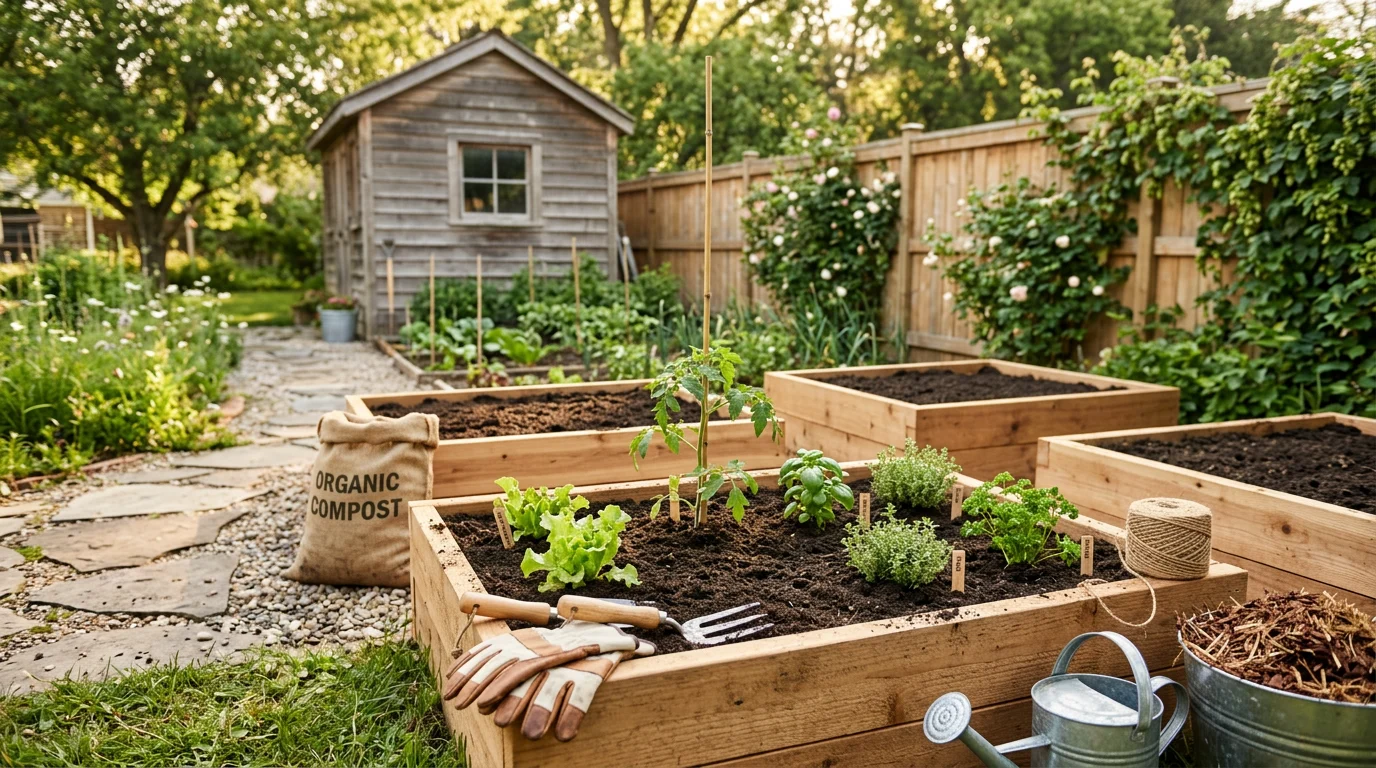
This beginner’s guide to an organic garden walks you through one small bed and one full first season, with the garden folklore sorted from what research backs.
Updated September 29, 2026 · 11 min read · For first-time gardeners
Key Takeaways
- Spend on soil, not gear. It is the one part of the garden that gets better every year you feed it.
- Start with one bed you can reach across. About four feet wide works for most people.
- Most vegetables want six or more hours of direct sun and about one inch of water a week.
- Most companion planting charts rest on anecdote. Still, a few pairings hold up, and marigolds do far less than their fame suggests.
- In a farm trial running since 1981, organic corn and soybean yields match regular farming, and organic corn came in 31% higher in drought years.
Most first gardens fail in July, not May. The bed was too big, the soil was thin, and the weeds won.
So this organic garden plan keeps it small and puts the soil first. Then it sorts the advice that holds up from the advice that just gets copied.
Here is the whole first season: one bed, good soil, and crops you actually eat.
In this guide
Why organic pays off, planning your bed, building the soil, what to plant and when, pest control that holds up, watering and upkeep, four beginner mistakes, and what to buy.
Why an organic garden pays off
Most beginners assume organic is the harder path. But it is mostly a different order of steps.
Synthetic fertilizer feeds the plant and skips the soil. Broad sprays kill the pests, and they also kill the bugs that were eating the pests. So the garden ends up needing those inputs just to keep going.
Organic flips that. First you build the soil, and then the soil does the feeding.
The yield case is strong, too. The Rodale Institute has run its Farming Systems Trial since 1981, across 72 test plots. Rodale calls it America’s longest-running side-by-side test of organic and chemical farming.
In normal years, organic corn and soybean yields match regular yields. In drought years, in fact, organic corn has come in 31% higher.
Spend more on soil at the start, and you spend less fixing problems every season after.
Plan the bed before you buy anything
The biggest beginner mistake is size. A garden that overwhelms you gets skipped, and a skipped garden turns into weeds by July.
For scale, University of Maryland Extension calls 50 to 75 square feet a good starter size. One four-by-eight bed is 32 square feet, which is a fine first step below that.
Find the sun first
Most vegetables want at least six hours of full sun a day, and more is better. So walk your yard a few times on a clear day and watch where the light lands. Often it is not where you assumed.
Then skip the low spot where water sits after rain. Roots need air, and soaked ground has little of it.
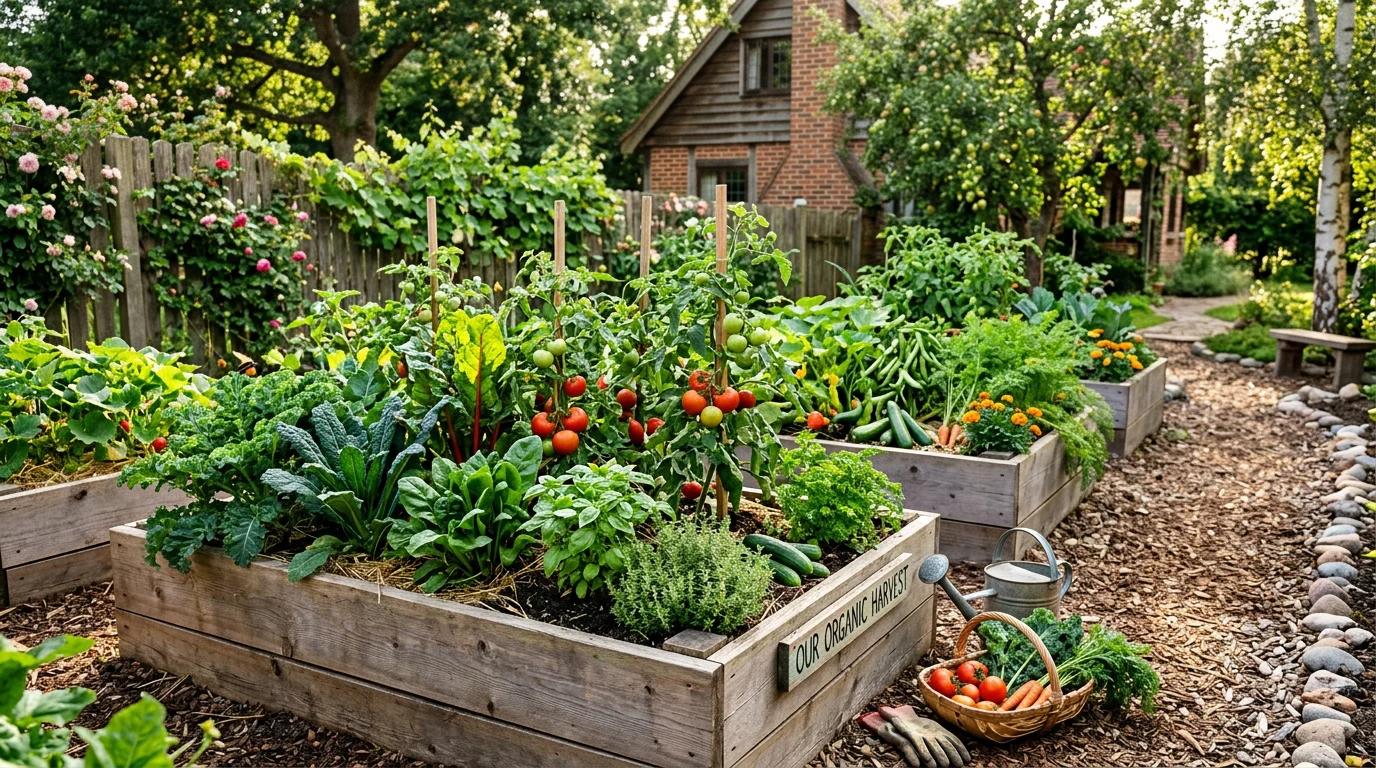
Raised beds win for beginners
With a raised bed, you control the soil from day one. Also, the soil warms faster in spring and tends to have fewer stubborn weeds, per University of Minnesota Extension.
Cedar costs more than pine, but it lasts longer. Either works. However, skip railroad ties and wood treated with CCA, since some of its arsenic can leach into the soil.
Make it narrow enough to reach the middle
The rule is simple: you should reach the center without stepping in. Standing on the soil packs it down right where roots need to move. For a bed you can reach from both sides, Minnesota Extension puts the limit near five feet, so four feet leaves you room to spare.
Then put tall crops on the north and west sides, so they do not shade the short ones.
Build the soil, because it does the work
Most guides rush this part. Yet it is the part that decides your season.
Soil is not just dirt. Instead, it is full of microbes, fungi and worms that break down organic matter and feed roots. So the shift is easy to say and takes a season to believe: stop feeding the plant, and feed the soil.
The squeeze test
Grab a damp handful and squeeze. Good soil holds its shape for a second, then crumbles when you poke it. A hard lump means heavy clay, a quick crumble means sand, and compost helps both.
A mix that works in a new bed
Minnesota Extension suggests about half to two-thirds topsoil, with the rest plant-based compost. If your topsoil is heavy clay, add some sand. But if you would rather skip the math, buy a bagged organic garden soil.
On a bag, look for the OMRI mark. OMRI, the Organic Materials Review Institute, is a nonprofit that decides which products are allowed in certified organic growing. It is a quick way to know a bag is what it says.
See OMRI-listed organic garden soil
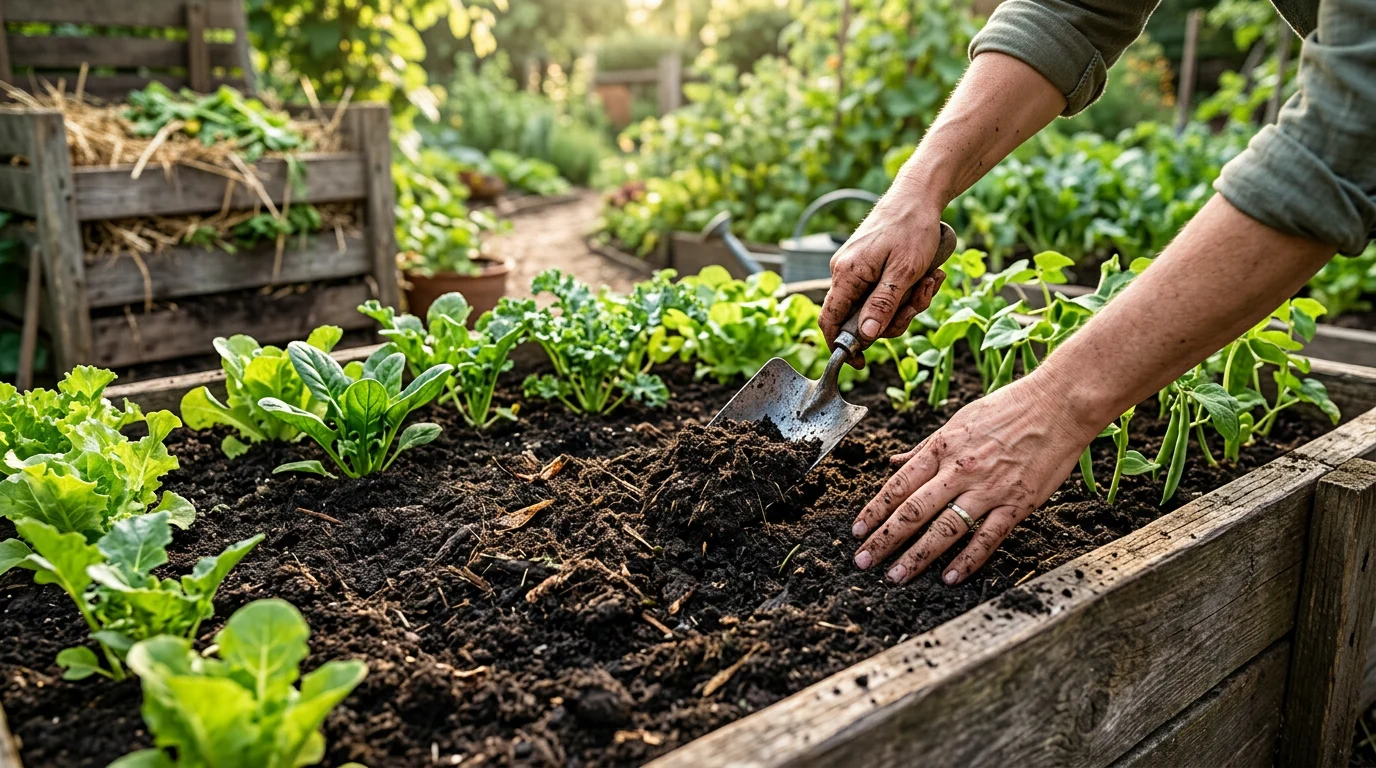
Compost is the one habit that compounds
Compost holds water, loosens packed ground, and feeds the life in your soil. For a new bed, Oregon State University Extension suggests three to four inches worked into the top 8 to 12 inches. After that, add a quarter inch to one inch each year.
You can make it, buy it bagged, or find a local source. The method matters far less than doing it every year.
If you want to start making your own, my guide to setting up a zero-waste kitchen covers which scraps go in.
Four organic fertilizers worth having
Most organic fertilizers release food slowly, per Colorado State University Extension. That is a plus, since slow food is hard to overdo.
- Worm castings. Very mild. The LSU AgCenter says they will not burn plants, so they are a safe first pick.
- Fish emulsion. A liquid feed made from fish waste, and famous for its foul smell.
- Kelp meal. Prized for trace nutrients, not for bulk feeding.
- Bone meal. A slow source of phosphorus. However, plants can only use it in soil with a pH below 7.
See worm castings and fish emulsion
What to plant, and which tomatoes resist disease
First, grow what you want to eat. A perfect crop of something you never cook is a chore, not a win.
Six crops that are hard to fail with
- Tomatoes. The biggest reward, and the crop where variety matters most. See below.
- Zucchini. One or two plants will usually feed a whole household. Two is a dare.
- Salad greens. Fast growers that tolerate some shade, too.
- Bush beans. No staking needed, and very forgiving.
- Radishes. Ready in 25 to 35 days, per Maryland Extension. Good for gaps between slower crops.
- Basil, parsley, chives. Small footprint, constant kitchen use.
Heirloom or hybrid
Heirlooms grow true from saved seed, so you get the same plant next year. Their flavor is often better than hybrids, says Illinois Extension. On the other hand, their disease resistance is a coin flip.
Hybrids, marked F1, are bred for traits like disease resistance and yield. Still, saved hybrid seed will not grow true to the parent plant.
Worth knowing
Famous heirlooms such as Brandywine and Cherokee Purple are grown for flavor, not toughness. In fact, Cornell says Brandywine has poor disease resistance, with catalog listings for only early blight and fulvia blight. So if disease worries you, pick an F1 hybrid from Cornell’s resistant-variety list, such as Celebrity, Big Beef, Stellar or Mountain Magic.
So the practical answer is to grow both. A variety pack of heirlooms lets you taste-test several kinds in one season. Then add one resistant hybrid tomato as insurance.
See heirloom seed variety packs
Timing comes down to your last frost date
Cool crops like lettuce, spinach, peas and broccoli go in several weeks to a couple of months before your last spring frost, says Penn State Extension. Warm crops like tomatoes, peppers, squash and beans wait until after it, once the soil and air are warm.
The Old Farmer’s Almanac frost date tool gives your average last spring frost by zip code, based on the nearest weather station. Bookmark it, since you will want it every March.
Pest control: what holds up and what does not
Pest advice is where garden folklore runs thickest. So here is what the research says.
What the research supports
UMass Extension puts it plainly. There are few rigorous studies on companion planting, compared with the pile of books and charts built on anecdote. Still, a few ideas hold up.
- Flowering herbs bring in helpers. Basil, cilantro, dill, fennel and parsley give food and shelter to the bugs that hunt your pests. So let some herbs flower.
- The Three Sisters work by design. Corn stalks act as a trellis for pole beans, while winter squash shades the ground to hold moisture and block weeds.
- Mixing helps a little. In a University of California test with broccoli, aphid numbers fell as more varieties were mixed in the plot.
- Basil and marigolds together cut thrips on tomatoes in a few studies, per Mississippi State Extension. Overall, their verdict on companion planting is “sometimes yes, sometimes no.”
The marigold myth
Marigolds are sold as all-purpose pest fighters, yet UMass says very little evidence backs that fame. Their real effect is on root nematodes, and only after you grow them as a cover crop and till them in, so a few dotted between tomatoes will not do it. They are still pretty, but they are not a pesticide.
Keep the helpful insects you already have
Ladybugs, lacewings, spiders and predatory mites do free pest control in your garden. So let herbs flower, and skip broad sprays that kill them along with the pests.
When you do have to spray
Start with the mildest option. Neem oil and insecticidal soap both target soft-bodied pests like aphids, whiteflies and mites, but only if the spray touches them, per Clemson Extension. Bt, short for Bacillus thuringiensis, is a bacterium, and the kurstaki type only harms caterpillars.
Bees get some good news here, too. Cornell Cooperative Extension says insecticidal soap is not toxic to pollinators once the spray dries, and neem stops being toxic to bees after about two hours. Even so, spray at dusk, at night or at dawn on any plant pollinators visit.
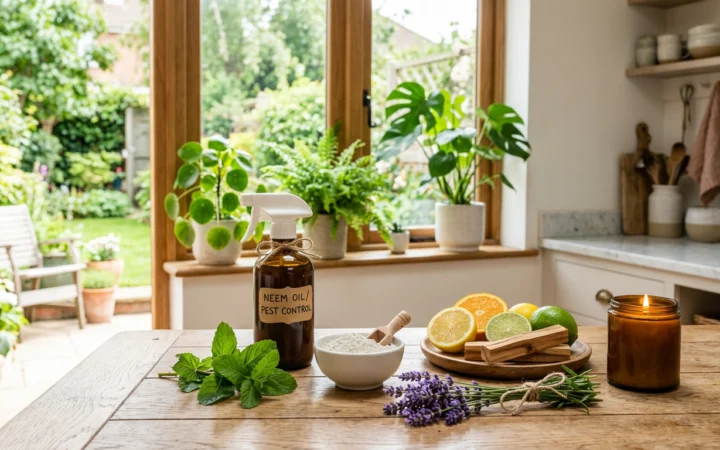
See neem oil and organic pest sprays
Watering and upkeep
Water deep, and water early
University of Minnesota Extension puts the target at one inch of water a week. That comes to about 62 gallons per 100 square feet. Sandy soil may need water twice a week, while clay or loam is fine with once.
Before you water, check. Pull back the mulch and dig down two inches. If the soil is dry at that depth, it is time.
Water early in the day, too. Leaves that stay wet into the evening invite leaf disease, so a drip line or soaker hose beats a sprinkler. Still, never wait when plants are wilting.
Mulch once and forget it
Spread two to four inches of straw or shredded leaves after planting. It holds moisture, holds back weeds, and feeds the soil as it breaks down, per Minnesota Extension. Keep a gap between the mulch and plant stems.
Weed while they are small
Pull weeds when they are young, says Maryland Extension, because big weeds take lots of water and food from the soil. Also, a short pass with a hand tool each week beats a lost afternoon in August.
Rotate your crops
Planting the same family in the same spot lets soil diseases and pests build up. Clemson Extension says to grow a crop in one spot no more than once every three years, and four or five is better. Four groups is enough bookkeeping for a home garden.
| Bed | First year | Second year | Third year | Fourth year |
|---|---|---|---|---|
| Bed A | Nightshades | Legumes | Roots | Brassicas |
| Bed B | Legumes | Roots | Brassicas | Nightshades |
| Bed C | Roots | Brassicas | Nightshades | Legumes |
| Bed D | Brassicas | Nightshades | Legumes | Roots |
Nightshades are tomatoes, peppers and eggplant, while brassicas are broccoli, cabbage and kale. Legumes are beans and peas, and roots are carrots, beets and radishes.
Four mistakes that end a first season
1. Skipping the soil and hoping
Put more of your starting money into compost and soil than into plants or tools. Nothing else you buy makes up for thin soil.
2. Watering a little every day
Maryland Extension warns that shallow, frequent watering leads to shallow roots, and shallow roots suffer first in a dry spell. Salad greens are the one exception. For everything else, use the two-inch check.
3. Crowding
Packed plants shade each other and dry slowly after rain. As a result, leaves stay wet longer, and wet leaves invite disease. In your first season, give plants the full spacing on the seed packet.
4. Putting tomatoes in the same spot every year
Early blight survives in the soil as spores from year to year, per Clemson Extension. Fusarium wilt can last for many years, says Minnesota Extension. So move tomatoes each year, and keep them out of spots where peppers, eggplant or potatoes just grew.
Where I would not oversell this
A few honest limits, because a guide that promises everything is not worth much.
- Year one costs the most. Soil, a bed and tools cost real money up front, and your first harvest likely will not pay it back.
- Vinegar only burns what it touches. It does not travel through the plant to the roots, per the National Pesticide Information Center. Also, kitchen vinegar is only 4 to 6% acid, while weed products run 20% or more and can badly hurt your skin and eyes.
- Copper spray is allowed in organic growing, but it is not harmless. Cornell notes copper can build up in soil with heavy use over the years. So treat it as a last resort.
- Shade is hard to fix. If your yard gets only a few hours of sun, grow lettuce, kale and other greens that tolerate shade, and skip tomatoes.
What to buy your first season
Seven things cover a first year, and they are the seven linked above. In order of what matters: soil and compost first, then the bed, then seeds, then a hand tool. The pest spray can wait until you see a pest.
Also, skip the huge tool sets. A trowel, a hand cultivator and bypass pruners do nearly everything in a kitchen garden.
Keep reading
Start with one bed this week
First, pick the sunniest spot you have and mark out four feet by eight. Then order soil and compost before you order seeds, since that is the part most people get backwards.
Finally, plant six things you like to eat, mulch the same day, and check the soil two inches down each week. That is the entire first season.
Frequently asked questions
How do I start an organic garden as a complete beginner?
Start with one raised bed narrow enough to reach the middle, about four feet wide, in a spot with at least six hours of direct sun. Fill it with good soil and compost, then plant easy crops like greens, beans, zucchini and herbs. Mulch after planting, and water deeply about once or twice a week instead of a little every day.
What is the best soil for an organic garden?
For a new raised bed, University of Minnesota Extension suggests about half to two-thirds topsoil, with the rest plant-based compost. If you buy bagged soil, look for the OMRI mark, which means the product is allowed in certified organic growing. After the first year, add a quarter inch to an inch of compost each season to keep the soil working.
Does companion planting actually work?
Some of it does, though UMass Extension notes that rigorous studies are few compared with the many charts based on anecdote. Flowering herbs do shelter helpful insects, and the Three Sisters works through how the plants grow. However, marigolds as a general pest repellent lack support; their effect on root nematodes needs them grown as a cover crop and tilled in.
How much should I water a vegetable garden?
About one inch per week, which University of Minnesota Extension figures at roughly 62 gallons per 100 square feet. Sandy soil may need water twice a week, while clay or loam is fine with once. Dig down two inches first and water only if the soil is dry there, ideally early in the day.
Is neem oil safe for bees?
Mostly, once it dries. Cornell Cooperative Extension says neem stops being toxic to bees after about two hours, and insecticidal soap is not toxic to pollinators once the spray dries. The risk is wet spray landing on a working bee, so apply at dusk, at night or at dawn on any plant that pollinators visit.
Sources (checked September 29, 2026)
- Rodale Institute, Farming Systems Trial — running since 1981 across 72 plots; organic corn and soybean yields matching conventional; organic corn 31% higher in drought years.
- Cornell Vegetables, Disease-Resistant Tomato Varieties — Brandywine’s listed resistances and the named resistant hybrids (compiled from 2018–2022 seed catalogs).
- Cornell CALS, Which Tomatoes Should I Grow? — Brandywine’s poor disease resistance.
- Illinois Extension, F1 Hybrid vs. Heirloom Vegetable Seed — seed saving, flavor, and disease resistance of heirlooms and hybrids.
- UMass Extension, Companion Planting in the Vegetable Garden — the thin evidence base, flowering herbs, helpful insects, the Three Sisters, the UC broccoli study, and marigolds and nematodes.
- Mississippi State Extension, Companion Planting: Myth or Truth? — the basil and marigold thrips studies and the mixed verdict.
- University of Minnesota Extension, Watering the Vegetable Garden — one inch per week, 62 gallons per 100 square feet, soil-type frequency, the two-inch check, early watering, drip and soaker hoses.
- University of Maryland Extension, Caring for Your Vegetable Garden — shallow watering and shallow roots; pulling weeds young.
- Cornell Cooperative Extension, Low-Impact Pesticides — insecticidal soap non-toxic to pollinators once dry, neem’s two-hour window, spray timing.
- Clemson HGIC, Less Toxic Insecticides — pests targeted by soap and neem, contact action, Bt kurstaki and caterpillars.
- University of Minnesota Extension, Raised Bed Gardens — raised-bed benefits, CCA lumber and arsenic, bed width, soil mix, cedar versus pine, shade-tolerant greens.
- University of Maryland Extension, How to Start a Vegetable Garden — six hours of sun, starter size, tall crops on the north and west.
- Penn State Extension, Cool-Season vs. Warm-Season Vegetables — planting timing around the last frost date.
- Organic Materials Review Institute, About OMRI — what OMRI is and what the OMRI Listed mark means.
- Oregon State University Extension, How to Use Compost in Gardens and Landscapes — compost rates for new and established beds, and what compost does.
- Colorado State University Extension, Organic Fertilizers — slow release, fish emulsion, kelp, bone meal and soil pH.
- LSU AgCenter, Composting Series: Worm Castings — worm castings will not burn plants.
- Clemson HGIC, Crop Rotation — disease and pest buildup, three-year minimum rotation, nightshade family.
- University of Minnesota Extension, Fusarium Wilt — fusarium surviving many years in soil.
- Clemson HGIC, Cultural Management of Tomato Diseases — early blight spores surviving in soil; tomato relatives.
- National Pesticide Information Center, Can I Use Vinegar to Control Weeds? — vinegar as a contact-only weed killer, acid strength, and eye and skin hazards.
- Cornell Vegetables, Copper Fungicides for Organic Disease Management — copper allowed in organic growing and building up in soil.
- University of Minnesota Extension, Mulching for Soil and Garden Health — two to four inches, straw for vegetables, a gap at the stems.
- University of Maryland Extension, Growing Radishes in a Home Garden — 25 to 35 days to harvest.
- Old Farmer’s Almanac, Frost Dates Calculator — average last spring frost by zip code.
What worked in your first season?
If you have grown for a year or two, tell me through the contact page which crop surprised you and which one you would skip. The most useful tips usually come from someone one season ahead.