4 Eco Friendly Cleaning Products That Actually Check Out
This post has affiliate links. As an Amazon Associate I earn from qualifying purchases, at no extra cost to you. How I pick products.
Most green labels are just paint. Here’s the free 30-second check I run on eco friendly cleaning products now, and the four that passed it.
Key Takeaways
- The EPA keeps a free list of nearly 2,000 products that passed its Safer Choice review. Also, you can search it in the store aisle.
- “Green” and “eco-friendly” prove nothing, and the FTC tells companies not to use them without specifics. Instead, look for Safer Choice and DfE, the EPA’s two reviewed marks.
- A safer cleaner is not a germ killer. In fact, those are two different EPA programs, and mixing them up is the mistake I see most.
- “Fragrance” can stand for a whole blend, and U.S. law doesn’t make companies list every ingredient.
- Start with one bottle. After all, your kitchen spray is the one your hands touch most.
For years I thought I was buying safer cleaners. But I was buying nicer labels.
One afternoon I pulled everything out from under my sink and turned each bottle around. First, the leaf on the front. Then the soft green type.
Also, the word “natural” showed up three times. Finally, the back, where one bottle listed “fragrance” and nothing else about what that meant.
So that bottle went in the trash. Later, I found out you don’t have to trust any label. In fact, there’s a free government database that does the work for you, and it takes about 30 seconds.
The 30-second check for eco friendly cleaning products
The EPA runs a program called Safer Choice. Before a product can carry the label, the EPA reviews every chemical ingredient in it, no matter how small the amount. Then, if it passes, it earns the label and goes on a public list.
As of September 2026, that list holds nearly 2,000 products. Also, it’s free, it’s searchable, and you can pull it up on your phone while you’re standing in the aisle. That’s the check: type in the brand and see if it’s there.
Here’s what the EPA looks at before a product makes the list:
- Cancer risk from any ingredient
- Harm to a pregnancy or a growing child
- Harm to fish and other water life
- Whether it breaks down or sticks around in the environment
- How well it cleans. In other words, it has to work about as well as a regular cleaner.
- Its pH, its packaging, and its VOCs
VOCs are chemicals that escape into the air as gas. For example, the EPA lists cleansers and disinfectants among the household products that give them off. Also, the American Lung Association links the VOCs from cleaners to ongoing breathing problems, allergic reactions, and headaches.
You don’t have to trust the front of the bottle. Somebody already read the back of it for you.
Worth knowing
Not on the list doesn’t mean bad, because the program is voluntary and a company has to apply. So treat the list as proof, not as a blacklist. However, if a brand isn’t on it, you’re back to reading the label yourself.
Four red flags that make me put a bottle back
When a product isn’t on the EPA list, I read the back and look for these. If I see any one of them, then I set it down.
1. “Fragrance” with nothing after it
That one word can stand for a whole blend. The Lung Association notes that U.S. law doesn’t make companies list every ingredient in consumer products. So the bottle may never tell you what’s in it.
The Lung Association also makes a point that surprised me. Even natural scents like citrus can react indoors and form new pollutants.
2. Chlorine bleach or ammonia
These are the two I’m most careful with. But mixed together, they’re dangerous. The Lung Association warns that the gases from that mix can cause long-term breathing problems and even death.
3. Preservatives that give off formaldehyde
These go by names most people don’t know, like DMDM hydantoin and quaternium-15. For example, the FDA lists both as formaldehyde releasers and common allergens in cosmetics. If a name on the label means nothing to you, look it up before you buy.
4. Almost no ingredient list
A brand that lists everything is telling you something. Likewise, a brand that lists almost nothing is telling you something too.
If you want to dig deeper, check the brand’s website. California is stricter than federal law: its Cleaning Product Right to Know Act has required ingredient information online since 2020 and on labels since 2021, for products sold in that state.
The four cleaners I keep under my sink
These are the ones that stuck after two years. Also, I’m telling you the annoying part of each one, because every one of them has one.
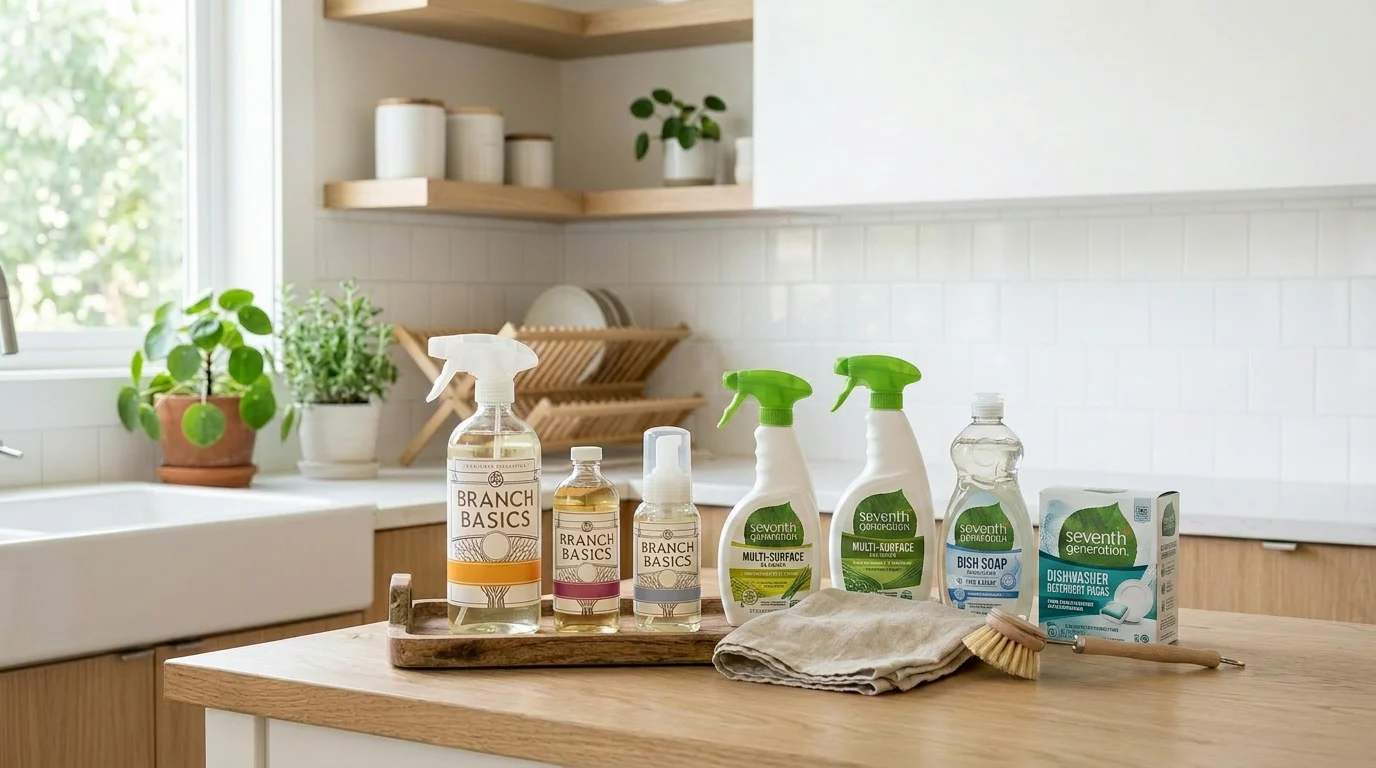
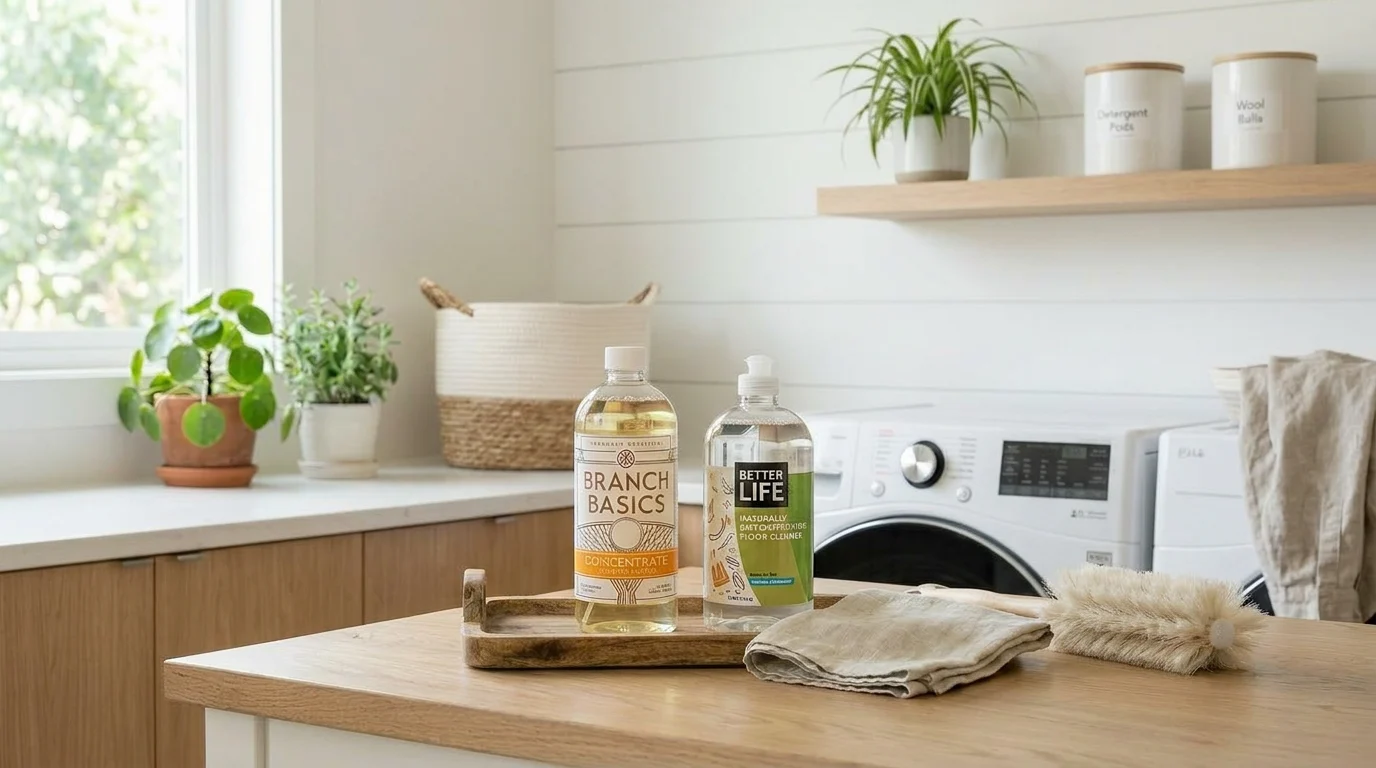
Branch Basics Concentrate
Best for: the whole house, one bottle · Outside proof: MADE SAFE certified
Plant- and mineral-based, and fragrance-free. First, you mix it with water in a spray bottle, and the same concentrate handles counters, glass, and laundry. Mine has been going since spring.
It isn’t on the EPA list. However, it does carry the MADE SAFE seal, which I confirmed on MADE SAFE’s own product listing.
The annoying part: the price up front feels steep, and diluting it yourself feels wrong for about a week. But it isn’t wrong. After all, you’re used to paying to ship water.
Blueland Multi-Surface Cleaner
Best for: cutting plastic · Outside proof: EPA Safer Choice
You keep one bottle and drop in a tablet when it runs out. As a result, there’s no new plastic bottle every time.
Blueland’s Multi-Surface Cleaner is on the EPA’s Safer Choice list. So I checked it myself in September 2026, and you can too.
For example, I tried it at my parents’ house. My dad never noticed anything different, which is the whole point.
The annoying part: you have to wait for the tablet to dissolve. So fill it before bed, not while you’re mid-clean.
Seventh Generation Tub & Tile Cleaner
Best for: bathrooms, easy to find · Outside proof: EPA Safer Choice (Fresh Mint)
It uses plant-derived cleaning agents, and the Tub & Tile Cleaner in Fresh Mint is on the EPA’s Safer Choice list. Seventh Generation lists more than 40 of its products as Safer Choice certified. In addition, it says it won the EPA’s 2021 Safer Choice Partner of the Year award.
Also, being easy to find matters more than eco blogs admit. The best cleaner is the one you can grab on a Tuesday when you’re out.
Check the scent: the brand’s site also sells an Emerald Cypress & Fir version and calls it Safer Choice certified. As of September 2026, only Fresh Mint showed up in the EPA’s data, so search the exact bottle you’re buying.
The annoying part: the spray nozzle. As a result, it fans wide and wastes product.
Better Life Floor Cleaner
Best for: floors, no film · Outside proof: none I could confirm
No heavy scent to my nose, and it dries without that sticky film that grabs every footprint. For example, I ran it before my nephews came over, and the floor didn’t smell like anything an hour later.
The annoying part, and I want to be straight here: Better Life isn’t on the EPA’s Safer Choice list. I searched the EPA’s data in September 2026 and found no Better Life products.
Still, that doesn’t make it a bad product, and I still use it. However, it does mean this pick rests on my own use, not on an outside review.
Why a safer cleaner is not a germ killer
This is the part lots of lists get wrong. In fact, mine did too, before I looked it up.
Safer Choice is about everyday cleaning. On the other hand, killing germs is a different job with its own EPA process. Germ killers are pesticides under federal law, so the EPA has to register them.
The gentler ones can carry a second EPA mark called DfE, short for Design for the Environment. Because of this, “EPA-approved disinfectant” is sloppy wording. The EPA registers them, and the mark to look for on a safer one is DfE, not Safer Choice.
Buying tip
The active ingredients on the EPA’s DfE disinfectant list are hydrogen peroxide, citric acid, ethanol, lactic acid, and isopropanol. So look for one of those names on the label.
Still, most days you don’t need one. The CDC says cleaning with soap or detergent and water removes most harmful germs from surfaces. Because of this, soap and water is plenty for a counter you wiped crumbs off.
When I still reach for the strong stuff
I’m not going to pretend a plant-based spray is the right call every time. Instead, here’s where it isn’t.
- Raw meat juice on the counter: the USDA says to wash every surface raw meat touches with hot, soapy water. For cutting boards, it gives a sanitizing mix of 1 tablespoon of unscented liquid chlorine bleach per gallon of water.
- Someone in the house is sick: the CDC says that’s the time to disinfect. Similarly, the same goes if someone at home has a weakened immune system. Focus on high-touch spots like doorknobs, light switches, and counters.
- Mold on a hard surface: here the gentle route is the EPA’s own advice. It says to scrub mold off with detergent and water, dry it completely, and fix the leak, because moisture control is the key. In contrast, it doesn’t recommend bleach as a routine fix.
- You’re out of the good stuff: a clean house beats a pure shopping list. So use what you have and open a window. The CDC’s rule is simple: never mix products or chemicals with each other.
This post is general information, not medical advice. If someone swallows or breathes in a cleaning product, call Poison Help at 1-800-222-1222.
All four at a glance
| Cleaner | Best for | Outside proof | Pick it if |
|---|---|---|---|
| Branch Basics | Whole house | MADE SAFE certified | You want one bottle instead of six |
| Blueland | Less plastic | EPA Safer Choice | You’re tired of buying bottles |
| Seventh Generation Tub & Tile | Bathrooms | EPA Safer Choice (Fresh Mint) | You want it at your grocery store |
| Better Life | Floors | None I could confirm | You go barefoot and hate sticky floors |
Start with one bottle
Don’t replace everything this weekend. Otherwise, you’ll spend a lot, and half of it will sit unused.
Instead, pick the kitchen spray. After all, it’s the one you use most, the one your hands touch, and the one that lands closest to your food.
Then search that brand on the EPA Safer Choice list. If it isn’t there, read the back for those four red flags. Finally, buy one replacement and use it until it runs out.
That’s the whole method. In short: one bottle, one check, and you never have to trust a leaf on a label again.
Your turn
Which bottle under your sink are you checking first? Tell me through the contact page, and if it isn’t on the EPA list, I’ll help you read the back of it.
Frequently asked questions
Do eco friendly cleaning products actually work?
The certified ones do, because cleaning power is part of the test. To earn the EPA Safer Choice label, a product has to pass performance standards and work about as well as a regular cleaner. In my experience, you may need to let a plant-based spray sit a few seconds longer before you wipe.
How do I check if a cleaner is really safe?
Search the EPA Safer Choice product list on the EPA website. Also, it’s free and held nearly 2,000 products as of September 2026. If the brand isn’t there, read the back and put it back if you see “fragrance” with no detail, chlorine bleach, ammonia, or formaldehyde releasers like DMDM hydantoin.
Is fragrance-free the same as unscented?
Not always. The FDA warns that some personal care products labeled “unscented” contain just enough fragrance to hide other smells, and it says “fragrance-free” has no federal definition. So for cleaners, the surest sign is the EPA’s fragrance-free version of the Safer Choice label.
Do green cleaners kill germs?
Most don’t, and they aren’t meant to: germ killers are pesticides that the EPA registers under a separate program from Safer Choice. Instead, for a gentler one, look for the EPA’s DfE logo. The active ingredients on that list are hydrogen peroxide, citric acid, ethanol, lactic acid, and isopropanol.
Are refill and tablet systems worth it?
If cutting plastic is your goal, yes. You reuse one bottle and add water at home instead of buying a new plastic bottle each time you run out. The trade-off is small: a concentrate needs mixing, and a tablet needs time to dissolve before you can spray.
What does the EPA Safer Choice label mean?
It means the EPA reviewed every chemical ingredient, no matter how small the amount. The review covers cancer risk, harm to reproduction and child development, harm to water life, and how long it lasts in the environment. In addition, the EPA checks how well the product cleans, plus its pH, packaging, and VOCs.
Sources (checked September 23, 2026)
- U.S. EPA, Learn About the Safer Choice Label: nearly 2,000 products; every ingredient reviewed; review criteria; performance standard; voluntary program; fragrance-free label.
- U.S. EPA, Safer Choice Product Search: the free, searchable product list.
- U.S. EPA Envirofacts, Safer Choice and DfE product data (searched by company and product name): Blueland Multi-Surface Cleaner and Seventh Generation Tub & Tile Cleaner Fresh Mint listed; no Branch Basics or Better Life records.
- U.S. EPA, DfE-Certified Disinfectants: the five active ingredients.
- U.S. EPA, Learn About DfE Certification: germ killers go through pesticide registration.
- U.S. EPA, VOCs’ Impact on Indoor Air Quality: what VOCs are; cleansers as a source.
- American Lung Association, Cleaning Supplies and Household Chemicals: VOC health effects; citrus scents; bleach and ammonia warning; no U.S. requirement to list all ingredients.
- Federal Trade Commission, Summary of the Green Guides: “green” and “eco-friendly” claims.
- U.S. FDA, Allergens in Cosmetics: formaldehyde releasers; no federal definition of “fragrance-free.”
- U.S. FDA, Fragrances in Cosmetics: “unscented” products with masking fragrance.
- California SB 258, Cleaning Product Right to Know Act of 2017: online (2020) and label (2021) disclosure dates.
- CDC, When and How to Clean and Disinfect Your Home: soap and water removes most germs; when to disinfect; high-touch surfaces; don’t mix products.
- USDA FSIS, Cleanliness Helps Prevent Foodborne Illness: hot, soapy water; cutting board sanitizing mix.
- U.S. EPA, Should I Use Bleach to Clean Up Mold?: detergent and water; moisture control; bleach not routine.
- Seventh Generation, The Safer Choice Label: list of 45 certified products; 2021 Partner of the Year award.
- Seventh Generation, Tub & Tile Cleaner: plant-derived cleaning agents; Emerald Cypress & Fir version labeled Safer Choice certified by the brand.
- Blueland, Multi-Surface Cleaner Refills: reusable bottle and tablet system.
- MADE SAFE, Branch Basics The Concentrate: MADE SAFE certified.
- Branch Basics, Is Branch Basics Safe?: plant- and mineral-based; fragrance-free; uses.
- HRSA, Poison Help: 1-800-222-1222.