Best Non-Toxic Dish Soap That Actually Cuts Grease (2026)
This post has affiliate links. As an Amazon Associate I earn from qualifying purchases, at no extra cost to you. How I pick products.
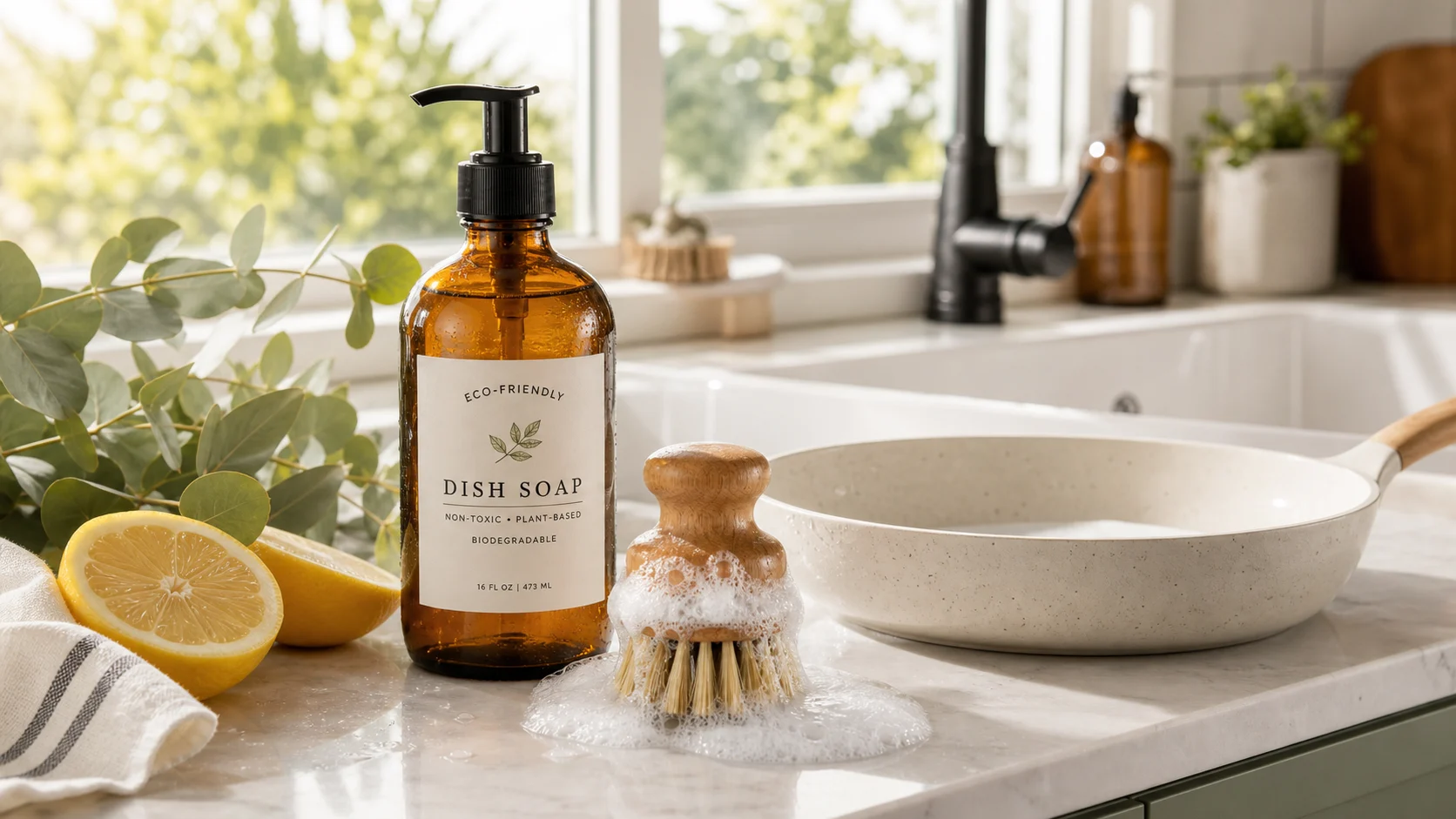
Most “plant-based” dish soap hides its scent behind one vague word. Here is the thirty-second check that catches it, plus six non-toxic dish soap picks that still cut grease.
Key Takeaways
- Dish soap is graded in EWG’s Guide to Healthy Cleaning, not Skin Deep, unless it doubles as body soap.
- An A grade and the EWG Verified mark are not the same thing. Plenty of good soaps have the first, but far fewer have the second.
- Of these six, two show the Verified badge on EWG’s own site: Attitude and Dr. Bronner’s. MADE SAFE, meanwhile, certifies the Branch Basics Concentrate.
- Also, three picks carry the EPA’s Safer Choice label: ECOS, Blueland, and Seventh Generation.
- Skip undisclosed fragrance first, because it is the one line on a label that can stand for a whole blend.
- Start with one pump, then add more only when the suds die down.
I once stood in the cleaning aisle for ten minutes flipping bottles over. Every front said plant-based or natural. But every back said fragrance, with nothing after it.
So that trip sent me down a rabbit hole, and this post came out of it. In the end, it gives you one label check, one database, and six soaps.
Each pick also says which mark it holds and where I confirmed it. After all, a leaf on the front is not proof.
Three things I check on a dish soap label
Learn these three, and then you can size up a bottle in under thirty seconds.
1. Fragrance with nothing after it
One word can stand for a whole blend, and the blend does not have to be listed. So it is the single biggest blind spot on any cleaning label.
If a brand names its scent ingredients, that also tells you something. But if it just says fragrance, you are trusting them.
2. SLS and SLES
These foaming agents show up in a lot of regular dish soap, too. SLS can irritate skin and eyes, and the Cosmetic Ingredient Review panel found that the irritation grows with strength and contact time. Still, the same panel calls it safe in products you rinse right off.
SLES, on the other hand, is made by a process that can leave a trace byproduct behind. I cover that further down, because the real story is milder than most blogs tell you.
Either way, neither one is required to clean a plate, so you can skip both. Castile soap, for example, is made from plant oils with no synthetic detergent at all.
3. DMDM hydantoin
Third, a preservative that gives off small amounts of formaldehyde as it sits in the bottle. A 2023 study in the International Journal of Toxicology explains that it keeps releasing formaldehyde until it reaches a balance point.
The National Cancer Institute says formaldehyde causes myeloid leukemia and some rare cancers. However, that finding comes from studies of workers breathing high levels on the job, such as embalmers and factory workers.
So I will not tell you a squirt of dish soap will hurt you. Still, it is easy to avoid, and I would rather avoid it. That is the whole reasoning.
The thirty-second check: use the right EWG database
EWG runs two separate databases, and dish soap usually lives in only one of them. Skin Deep covers shampoo, lotion, and makeup, while cleaning products sit in EWG’s Guide to Healthy Cleaning. So search there first.
Then type the brand, and you get a hazard grade from A to F or a Verified badge. That is the check. In fact, it takes about as long as reading this paragraph.
There is one exception, though. If a soap is also sold for your body, like castile soap, it may show up in Skin Deep instead. That is where you will find the castile pick below.
Worth knowing
A letter grade and the EWG Verified mark are two different things, because the grade is EWG’s own hazard score. Verified, by contrast, is a separate program a brand applies to, and it requires every ingredient on the label plus supplier and concentration data. So a soap can earn a clean A and still not be Verified, and that is not a knock on the soap.
An A grade means nothing bad turned up, while a Verified mark means the brand opened the whole formula. Both are useful, but they are not the same claim.
The certifications worth knowing
Four marks come up again and again on dish soap, so it helps to know them. Still, only three of them tell you anything about what is in the bottle. They are also the same marks I look for in every product I pick.
EWG Verified from the Environmental Working Group
First, it requires full ingredient disclosure on the label, fragrance included, plus ingredient suppliers and amounts. Also, the rules are updated each year. So this is the highest bar on this list.
MADE SAFE from Nontoxic Certified
It screens a formula so that more than 15,000 substances on its banned and restricted list are avoided or limited. The list also covers carcinogens, hormone disruptors, flame retardants, high-risk pesticides, and toxic solvents. In short, it is strict and works ingredient by ingredient.
EPA Safer Choice from the U.S. EPA
Unlike the first two, this is a government program. Every ingredient must meet its criteria for human health and the environment, including cancer risk and harm to aquatic life. In fact, three of the six picks below carry it.
Leaping Bunny from the Leaping Bunny Program
It means no new animal testing, for ingredients or the finished product. That is worth having, but it says nothing at all about what is in the bottle. So do not read it as a safety mark.
Greenwashing check
Natural, green, and plant-based are easy words to print. But the FTC’s Green Guides tell brands not to use bare claims like green or eco-friendly, because they are nearly impossible to back up. So trust a logo from one of the programs above, since a leaf on the front is just a graphic designer.
The six non-toxic dish soap picks I would actually buy
So each one lists the mark it holds today, and where I confirmed it, as of September 2026.
1. Branch Basics Concentrate — best overall
Proof: MADE SAFE; EWG Verified per the brand Format: concentrate you dilute
One bottle of concentrate makes dish soap, all-purpose spray, and laundry soap, depending on how much water you add. Also, MADE SAFE’s own product index lists the Concentrate as certified. Branch Basics prints the EWG Verified mark on it too, although I could not find the Concentrate in EWG’s cleaning guide.
Also, it handles a greasy roasting pan without a second pass, which is the test I care about.
The annoying part: the price up front, and diluting it yourself feels wrong for a week. Also, Branch Basics says the formula is biodegradable, but the bottle is not.
2. Attitude Dishwashing Liquid — best certified scented option
Proof: EWG Verified Format: liquid, refill sizes available
When I checked EWG’s own site, both the Unscented and Citrus Zest versions of Attitude Nature+ Dishwashing Liquid carried the Verified badge. So you do not have to go fragrance-free to go clean, because the scented bottle lists its fragrance ingredients by name.
In fact, it got through a wok full of stir-fry residue in one round for me.
The annoying part: it is harder to find in a normal grocery store than the drugstore brands, so you are usually ordering it.
3. ECOS Dish Soap — best cheap bottle
Proof: EPA Safer Choice, EWG grade A (Free & Clear) Not EWG Verified
It uses plant-derived cleaners with no dye and no added scent, and it is a budget bottle, too. So it is the easy default. Also, EWG’s cleaning guide gives the Free & Clear version an A, and the EPA lists it as Safer Choice certified.
The annoying part: it is not EWG Verified, so do not pay extra thinking it is. Instead, it earns an A grade, which is a different thing. Also, the version matters, because EWG gives the Pear scent only a B.
4. Blueland Dish Soap — best for cutting plastic
Proof: EPA Safer Choice Format: powder in a refillable shaker
You keep one shaker and refill it, so you are not buying a new plastic bottle each time. The dish soap is a powder, so you pour a little on a sponge or dish, add water, and scrub. By contrast, the dissolving tablets are Blueland’s dishwasher product, not this one.
The annoying part: the powder takes a beat to get used to at first. Also, Blueland says not to mix it with water ahead of time, so you cannot turn it into a pump soap.
5. Dr. Bronner’s Pure-Castile — best multi-use
Proof: EWG Verified, USDA organic, Fair Trade Format: concentrated liquid
Emanuel Bronner started the company in 1948. Then in 2003, it became the largest personal care company certified under the USDA’s organic program, and it started using 100% post-consumer recycled plastic bottles that same year.
Castile soap is made from plant oils rather than synthetic detergents. Also, the Peppermint version shows the EWG Verified badge in Skin Deep. The brand says its Eucalyptus scent is the one that is not Verified, so pick another scent.
The annoying part: it barely foams, which threw me the first time. Still, warm water and a few extra seconds gets the same result.
6. Seventh Generation Free & Clear — best first swap
Proof: EPA Safer Choice, EWG grade C Format: liquid, sold everywhere
Then there is the one you can grab on a Tuesday at Target without planning ahead. Being easy to find matters more than eco blogs admit, because the best soap is the one you actually buy. Also, the Free & Clear Dish Liquid carries the EPA’s Safer Choice label and skips fragrance and dye.
The annoying part: it contains SLS and a preservative called methylisothiazolinone, so EWG grades it only a C. If your hands are sensitive, pick the ECOS instead. And stick to Free & Clear, since the scented bottles are different formulas.
Does SLES in dish soap carry a real 1,4-dioxane risk?
Because this worry shows up on almost every non-toxic list, it deserves a straight answer.
You will often read that SLES may carry 1,4-dioxane at harmful levels in household products. But the evidence does not show harm at those levels.
The FDA tracks this in cosmetics, since they use the same kinds of foaming agents. First, 1,4-dioxane forms as a byproduct when certain ingredients are made. So you can spot the candidates by PEG, polyethylene, or an -eth- in the name, as in sodium laureth sulfate.
In fact, an FDA survey found none detectable at all in 80% of products. Also, an international group of regulators found every recently reported level within acceptable exposure margins. Likewise, Europe’s consumer safety committee calls trace levels of 10 parts per million or less safe in cosmetics.
So skip SLES if you want. Just do it because you prefer a shorter ingredient list, not because a blog told you your dish soap is poisoning you.
The honest version
The strongest reason to switch is not a scary chemical. Instead, it is that undisclosed fragrance means you cannot know what you are buying. So a brand willing to list everything is a brand you can check, and that transparency is the thing worth paying for.
When this does not matter much
I would rather you keep this up than swap everything and quit, so here is where I think it is fine to relax.
- You rinse well and use a dishwasher for most loads. Then your hand soap touches your plates for seconds. So the mark chase matters less than it does for a leave-on product.
- Money is tight. So a grade-A bottle you can afford to rebuy beats a Verified bottle you cannot. Buy the ECOS and then stop thinking about it.
- You have a half-full bottle of the old stuff. Finish it first. After all, throwing out working product to buy cleaner product is its own kind of waste.
- Your hands are the actual problem. If washing up leaves your skin cracked, that is a job for gloves and a fragrance-free formula, not for a better mark.
All six side by side
| Soap | Best for | Outside proof | Pick it if |
|---|---|---|---|
| Branch Basics | One bottle for many jobs | MADE SAFE; EWG Verified per the brand | You want the strictest proof you can get |
| Attitude | A scent you can trust | EWG Verified | You want scented but fully listed |
| ECOS | The budget default | EPA Safer Choice, EWG grade A | You want good and cheap |
| Blueland | Less plastic | EPA Safer Choice | You are done buying bottles |
| Dr. Bronner’s | Many jobs, one bottle | EWG Verified, USDA organic, Fair Trade | You want the simplest formula |
| Seventh Generation | Buying it today | EPA Safer Choice, EWG grade C | You want it at your grocery store |
Use less than you think
One or two pumps usually handles a full sink, because more soap does not mean cleaner dishes. Instead, it means more rinsing and a shorter bottle.
So here is a better signal. The American Cleaning Institute says hand dish soap makes suds partly to show that cleaning power is still left. So start with one pump, and add a second only when the suds die down or you hit a roasting pan.
Finally, pick one bottle from the list and use it until it runs out. That is the entire assignment.
This is general information, not medical advice. If a cleaning product leaves your skin cracked or irritated, stop using it and talk to a doctor or a dermatologist.
Frequently asked questions
What makes a dish soap non-toxic?
In practice, it means the label lists every ingredient and skips hidden fragrance, dyes, and preservatives that give off formaldehyde. But the word on its own proves nothing, so look for an outside check instead. That could be an EWG grade, the EWG Verified mark, MADE SAFE, or the EPA’s Safer Choice label.
Where do I look up a dish soap’s rating?
Use EWG’s Guide to Healthy Cleaning, because Skin Deep covers shampoo, lotion, and makeup instead. Then type the brand, and you get a hazard grade from A to F or a Verified badge. If the soap is also sold as body wash, like castile soap, check Skin Deep too.
Is an EWG grade the same as EWG Verified?
No, a grade is EWG’s own hazard score, while EWG Verified is a separate program a brand applies to. Verified also requires every ingredient on the label, fragrance included, plus supplier and concentration data. So a soap can earn an A and still not be Verified, and both are useful signals.
Is SLS in dish soap dangerous?
SLS can irritate skin and eyes, although an expert safety panel calls it safe in products you rinse right off. As for SLES, an FDA survey of cosmetics found no 1,4-dioxane, its trace byproduct, in 80% of products. So skip both if you prefer, but without alarm.
Can I use hand dish soap in a dishwasher?
No, because Whirlpool warns that hand dish soap makes a thick foam that can overflow through the dishwasher door. So use a detergent made for machines instead. Branch Basics Dishwasher Tablets and Blueland’s fragrance-free dishwasher detergent both show the EWG Verified badge in EWG’s cleaning guide.
How much dish soap should I use?
Start with one or two pumps in a full sink, then add a little more only when the suds die down. The American Cleaning Institute says hand dish suds show there is still cleaning power left, so fading suds are your cue. Using less also means less rinsing and a longer-lasting bottle.
Sources (checked September 29, 2026)
- Environmental Working Group, Guide to Healthy Cleaning — the database for cleaners and its A to F grades.
- Product listings in that guide for ECOS Free & Clear, the ECOS brand page, Attitude Citrus Zest and Unscented, Branch Basics, Blueland, and Seventh Generation Free & Clear — the grades, badges, and marks named for each pick.
- EWG Skin Deep, Pure-Castile Soap, Peppermint listing — the Verified badge on the castile pick.
- EWG, Cleaning Product Standards for the EWG Verified Program — full label disclosure including fragrance, supplier and concentration data, and yearly updates.
- U.S. Environmental Protection Agency, Learn About the Safer Choice Label and Safer Choice product search — the ingredient criteria and the ECOS, Blueland, and Seventh Generation listings.
- Nontoxic Certified, MADE SAFE and its listing for Branch Basics The Concentrate — the 15,000-plus banned and restricted substances and the certification.
- Leaping Bunny Program, Frequently Asked Questions — no new animal testing for ingredients or finished products.
- U.S. Food and Drug Administration, 1,4-Dioxane in Cosmetics, a Manufacturing Byproduct — how it forms, the 80% none-detected figure, the ICCR review, and the 10 ppm trace level.
- Cosmetic Ingredient Review, SLS and ALS safety summary — irritation that rises with strength and contact time, and safety in rinse-off products.
- National Cancer Institute, Formaldehyde and Cancer Risk — the worker studies behind the cancer finding.
- Stewart and others, International Journal of Toxicology (2023), risk assessment of DMDM hydantoin in shampoo — how the preservative gives off formaldehyde.
- American Cleaning Institute, Glossary of Cleaning Product Terminology — what hand dish suds signal.
- Whirlpool, Can You Use Dish Soap in the Dishwasher? — the foam overflow warning.
- Federal Trade Commission, Summary of the Green Guides — the warning against bare “green” and “eco-friendly” claims.
- Branch Basics, Is Branch Basics Safe? and The Concentrate — the brand’s EWG Verified claim, its uses, and the biodegradable formula.
- Blueland, Dish Soap Powder Starter Set — the powder format and how to use it.
- The castile brand’s own company history, Peppermint soap page, and EWG Verified FAQ — the 1948 founding, the organic and Fair Trade marks, the recycled bottles, and the Eucalyptus exception.
- Seventh Generation, Dish Soap, Free & Clear — the ingredient list.
Keep reading
Did I miss one?
If you use a dish soap that holds up and checks out, tell me through the contact page, along with the mark it carries. I would rather add a good one than defend a list.