Best Eco Friendly Shampoo for Every Hair Type and Budget
This post has affiliate links. As an Amazon Associate I earn from qualifying purchases, at no extra cost to you. How I pick products.
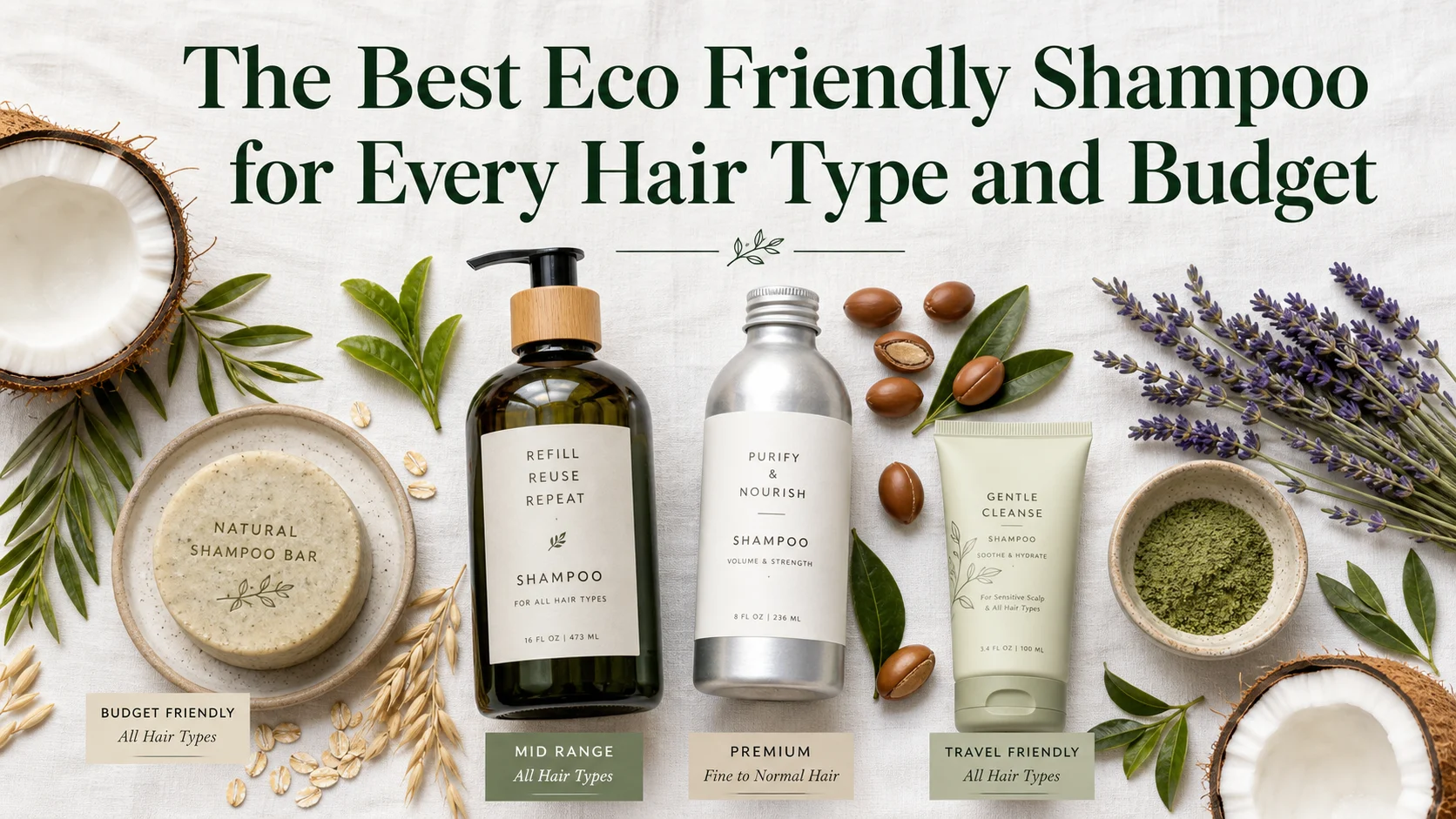
The best eco friendly shampoo is one whose back label holds up, so here is a quick label check and five brands that pass it.
Key Takeaways
- An EWG score is not EWG Verified. Acure’s Ultra Hydrating Shampoo scores a low 2 out of 10 on Skin Deep, yet it does not carry the Verified mark.
- No federal rule yet makes labels name fragrance allergens. Congress ordered one in 2022, but as of September 2026 the FDA only plans to propose it in November 2026.
- If your scalp reacts, skip SLS, MI/MCI and fragrance first. Those also have strong evidence behind them.
- Check your water too, because above 60 mg/L of hardness, true-soap formulas tend to leave a film.
- Finally, all five picks here hold the Leaping Bunny mark and publish a full ingredient list. Each one also has a real drawback, listed below.
A shampoo can score a 2 out of 10 in EWG’s database and still not be EWG Verified. In fact, that is true of the Acure shampoo in this guide.
That gap is also the whole problem with shopping by logo. After all, a score, a seal and a claim on the front can mean very different things. So the most reliable check is the back of the bottle.
First comes that check, in plain steps. After that come five eco friendly shampoo brands, each with the mark it actually holds and the one thing that bugs me about it.
What a shampoo label has to tell you now
For decades, cosmetics in this country ran under a 1938 law with few changes. Then in 2022 Congress passed MoCRA, short for the Modernization of Cosmetics Regulation Act. The FDA calls it the biggest expansion of its power over cosmetics since 1938.
So here is what changed. First, brands now have to register their plants and list their products with the FDA.
They also must report serious harm to the FDA within 15 business days. In addition, they have to keep records that back up a product’s safety.
But one promised piece is still missing. In fact, MoCRA told the FDA to make brands name fragrance allergens on labels, and a draft of that rule was due in 2024. Yet as of September 2026 it has not been issued, and the FDA now plans to propose it in November 2026.
Worth knowing
The FDA still does not approve a shampoo before it goes on sale. Its own site says the law does not require approval for cosmetics or their ingredients, other than color additives. So the label tells you more than it used to, but nobody checks the bottle for you.
The ingredients worth skipping first
Not every lab-made ingredient is a problem, and not every plant one is gentle. Still, these are the ones with the strongest case against them.
SLS, and the milder cleansers that replace it
First up, sodium lauryl sulfate cleans well and foams hard. But skin researchers use it on purpose as a known irritant, because it lowers the skin’s own moisture factor. That matters most when your scalp already reacts to things.
Sulfate-free formulas use gentler cleansers instead. For example, look for names like sodium cocoyl isethionate, cocamidopropyl betaine or coco glucoside. They clean fine, but they foam less, and foam was never the point.
MI and MCI
MI and MCI are preservatives found in some rinse-off products. The EU’s safety panel judged MI safe in rinse-off products only at a tiny 15 parts per million. For leave-on hair products, it found no level it could support as safe, because of the risk of contact allergy.
So if you have ever had a scalp reaction you could not explain, look for these two first. In fact, I would put them ahead of everything else on this list.
Fragrance
The word fragrance can stand for a whole blend rather than one thing. And until the FDA rule arrives, U.S. brands do not have to name the allergens inside it. As a result, fragrance-free is the only setting you can fully check if your scalp is touchy.
Parabens, told straight
The EU caps propyl- and butylparaben at 0.14% combined, and it also banned five other parabens outright. On the other hand, the FDA says it has no data showing parabens, as used in cosmetics, affect human health.
So here is the fair version. Parabens are easy to skip, since the swaps work. That is reason enough, so you do not need fear to make the call.
Cyclic silicones, which is a planet call
Silicones coat the hair shaft, so you get instant slip and shine. However, the cyclic kinds, D4, D5 and D6, are the real concern. The EU lists them as substances of very high concern, because they last a long time and build up in living things.
In fact, Europe has held D4 and D5 below 0.1% in rinse-off products like shampoo since January 2020. Then on May 16, 2024 it adopted a wider rule that reaches most other products after June 6, 2026. For cosmetics, including D6 in shampoo, the new limit starts after June 6, 2027.
As a result, the EU says it could cut up to 90% of their release into the environment.
The shampoo scare that is weaker than it sounds
You will see 1,4-dioxane on a lot of clean beauty lists, especially online. It is a byproduct that can form when some cleansers are made, so you will not see it named on the label.
It is real, but the numbers are calmer than the lists suggest. For example, in an FDA survey of cosmetics, about 80% of products had none they could detect. Also, safety reviews treat trace levels at or under 10 parts per million as safe.
If you still want to avoid it, the FDA names the clues, so look for PEG, “-eth-” as in sodium laureth sulfate, or “-oxynol-” in the ingredient list.
Skip an ingredient because the swap is just as good and costs the same. That is a better reason than fear, and it holds up when you check it.
Seals and scores: what each one proves
A seal is only as useful as what it checks. For example, one checks animal testing and another checks organic farming. So here is what the common ones mean, using the same test I explain in how I pick products.
| Mark | What it checks | What it does not |
|---|---|---|
| EWG Skin Deep score | A 1 to 10 hazard rating from the label | Not a seal the brand applied for |
| EWG Verified | Strict ingredient and disclosure rules; brands must apply | A good Skin Deep score does not earn it |
| USDA Organic | At least 95% organic ingredients, not counting water and salt | “Made with organic ingredients” needs only 70% and cannot use the seal |
| Leaping Bunny | No new animal testing, with suppliers held to it and open to outside audits | Says nothing about safety or the planet |
| B Corp | The company’s social and green practices | Covers the company, not the bottle |
So no single logo replaces the back label. Instead, use the marks to shortlist, then read the ingredients to decide.
Shampoo bar or liquid? Let your water decide
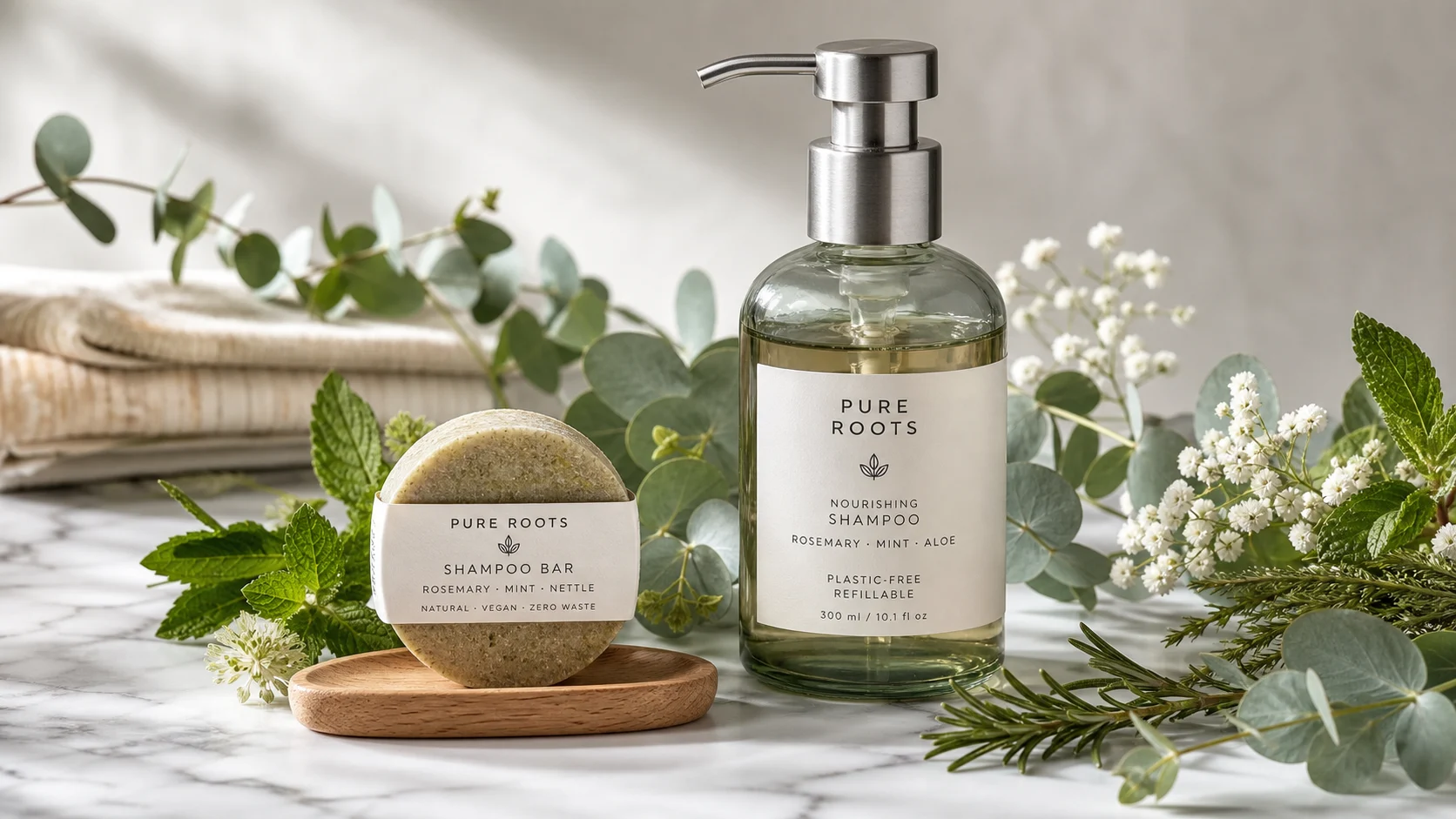
The plastic case for bars is strong. After all, a bar has no bottle, and it ships the working part of shampoo without the water. When you are cutting plastic room by room, bars pair well with these zero waste home swaps.
But how well a bar works depends on two things: what it is made of, and your water.
Step one: check the first cleanser
First, find the cleanser listed highest on the label, bar or liquid. For example, sodium cocoate, sodium olivate or other “saponified” oils mean true soap. On the other hand, sodium cocoyl isethionate means a soap-free detergent, which is a different product.
Step two: check your water
The USGS explains that soap reacts with the calcium in hard water and forms scum. That same scum can then cling to hair after a true-soap bar.
Also, your water utility’s yearly report may list hardness. Otherwise, a cheap test strip will tell you.
So here is the USGS scale, with the format I would pick at each level.
- 0 to 60 mg/L, soft: any format works, including true soap.
- 61 to 120 mg/L, moderately hard: skip true soap, so pick a soap-free bar or liquid.
- 121 to 180 mg/L, hard: again skip true soap, and a soap-free bar or liquid still works.
- Over 180 mg/L, very hard: a soap-free liquid is the easy route.
Two habits that fix most bar complaints
Rub the bar straight onto wet hair instead of lathering it in your hands. Then keep it on a dish that drains, because a bar left sitting in water turns soft and gets used up fast.
Five eco friendly shampoo brands that pass the label check
Every pick below holds the Leaping Bunny mark and prints a full ingredient list. Also, prices come from each brand’s own site and scores from EWG Skin Deep, both as of September 2026.
Acure: best first switch on a budget
Proof: Leaping Bunny since 2013 EWG: Ultra Hydrating scores 2, not Verified
Acure is the cheap, easy way in. Its Ultra Hydrating Shampoo costs $9.99 for 8 ounces, or about $1.25 an ounce. Acure also says it is vegan, sulfate-free and silicone-free.
In addition, EWG lists 192 Acure products, and this shampoo scores a low 2. That is a strong record for the price, even though it lacks the Verified mark.
The annoying part: even at a score of 2, EWG still gives this shampoo a high flag for allergy concerns. So if your scalp is sensitive, read the ingredients before you buy.
Briogeo: widest range for mixed households
Proof: Leaping Bunny since 2018 EWG: scores vary by product, not Verified
The range is the reason to buy it, since Scalp Revival targets flaking, itchy or oily scalps. Be Gentle, Be Kind is the soothing line, and its shampoo also rates low hazard on Skin Deep. So one brand can cover a house with very different heads of hair.
In addition, Briogeo says Scalp Revival is sulfate-free, silicone-free, vegan and safe for color-treated hair.
The annoying part: the scores swing a lot across the line. For instance, Super Moisture Shampoo scores a 4, and EWG flags its fragrance for allergy concerns. So check the exact bottle, not just the brand.
Innersense: best for curly, dry or sensitive scalps
Proof: Leaping Bunny since 2005 B Corp: since 2021 Organic: uses USDA organic ingredients, not USDA certified as a product
Overall, this is the strongest full system here for dry, coarse and curly hair. Its Hydrating Cream Hairbath is built for thirsty strands, and the brand also says it is silicone-free.
It also makes Clarity Hairbath, a fragrance-free shampoo meant for sensitive scalps. That is the one I would reach for when fragrance bothers you.
The annoying part: the price, because a 10-ounce hairbath costs $30, or about $3 an ounce. That is also well over twice what Acure costs.
HiBAR: best shampoo bar
Proof: Leaping Bunny since 2021 Format: soap-free bar, sodium cocoyl isethionate base
HiBAR makes four bars, called Volumize, Moisturize, Maintain and Soothe, so you can match one to your hair. Because the first cleanser is sodium cocoyl isethionate, these are soap-free bars, not true soap. HiBAR also says they are pH balanced and color-safe.
A bar costs $14.95, but HiBAR says one lasts as long as two bottles of liquid shampoo.
The annoying part: a bar needs a dry place to sit between washes, because otherwise it goes soft and wears down fast.
Plaine Products: best zero-plastic liquid for soft water
Proof: Leaping Bunny since 2017 Format: refillable aluminum bottle
You buy the shampoo, reuse the pump, then mail the empty bottle back with prepaid shipping. Then Plaine cleans it and refills it for someone else. So there is no throwaway bottle in the loop.
Plaine also says its shampoo is vegan and free of sulfates and silicone. It is the pick if you want a liquid with no plastic at all.
The annoying part: it is a true soap. Sodium cocoate and sodium safflowerate sit near the top of the list, so by the water check above, it suits soft water best. Refills also come by mail, so plan ahead.
Which one fits your hair
| Your hair | Pick | Why |
|---|---|---|
| First switch, tight budget | Acure | About $1.25 an ounce, low EWG score |
| Oily or flaky scalp | Briogeo Scalp Revival | Built for buildup and flaking |
| Dry, coarse or curly | Innersense Hydrating Cream | Richest formula here |
| Sensitive scalp | Innersense Clarity | Fragrance-free, the only setting you can fully check |
| Color-treated | HiBAR or Briogeo | Both brands label these color-safe |
| Soft water, no plastic | Plaine Products | Refillable liquid, no throwaway bottle |
| Hard water, no plastic | HiBAR | Soap-free bar, so no soap scum |
How to get through the first few weeks
The rough patch after a switch is common, but it passes. So knowing that ahead of time is what keeps you from quitting halfway.
When you move off a silicone shampoo, the coating on your hair stops getting topped up. But it does not vanish overnight. So hair can feel dry, waxy or flat for a while as it wears off.
Four things that speed it up
- Clarify once, on day one. A clarifying shampoo is made to strip old buildup in one go, rather than over a month.
- Switch the conditioner too. Otherwise it puts back the same coating the new shampoo just took off.
- Wash a little less. For example, stretching to every other day gives your scalp time to settle.
- Stop judging by foam. After all, less lather is how mild cleansers work. Instead, massage your scalp for a full minute.
Where a clean shampoo will not help
- It will not fix a scalp condition. Instead, flaking, itching or hair loss that sticks around needs a doctor, not a fourth new bottle.
- Finish the bottle you have. After all, tossing working shampoo to buy a greener one is its own waste.
- Some of this is taste. In fact, the silicone case is mostly about the planet, not your head. So if your hair loves dimethicone, make that trade on purpose.
- True soap is not for every home. For instance, in hard water, a soap-free bar or liquid is the easier choice.
This is general information, not medical advice. If you have ongoing scalp irritation, flaking or hair loss, see a doctor or a dermatologist rather than switching products again.
Frequently asked questions
Is an EWG score the same as EWG Verified?
A Skin Deep score is a hazard rating from 1 to 10 that EWG gives to products in its Skin Deep database. In contrast, EWG Verified is a separate mark a brand must apply for, with stricter rules. So a shampoo can score a 2 and still not be Verified, like the Acure pick here.
Does U.S. law require fragrance allergens on shampoo labels?
Not yet, even though MoCRA, the 2022 cosmetics law, told the FDA to write a rule that makes brands name fragrance allergens on labels. As of September 2026 that rule has not been issued, and the FDA plans to propose it in November 2026. Until then, fragrance-free is the only choice you can fully check.
Does the FDA approve shampoo before it is sold?
No, because the FDA says the law does not require cosmetics or their ingredients, other than color additives, to get its approval before they go on sale. MoCRA added registration and serious harm reports, but no review step. So reading the label is still your job.
Do shampoo bars work in hard water?
True soap reacts with calcium in hard water and forms scum, so bars made from saponified oils, such as sodium cocoate, tend to leave a film. However, soap-free bars made with sodium cocoyl isethionate are not soap. So if your water tests above 60 mg/L, pick a soap-free bar or a liquid without soap.
Why does my hair feel waxy after switching shampoo?
Often it is coating from your old products wearing off, and the feeling then fades within a few weeks. In hard water it can also be soap scum from a true-soap shampoo. So check that your shampoo is soap-free, and switch your conditioner too.
Is sulfate-free shampoo better?
For a sensitive scalp, often yes, because sodium lauryl sulfate is a well-studied skin irritant. For normal or oily hair, however, the difference is smaller. Sulfate-free formulas also foam less, but less lather does not mean your hair is less clean.
Sources (checked September 29, 2026)
- FDA, Modernization of Cosmetics Regulation Act of 2022 (MoCRA), for MoCRA as the biggest expansion of FDA cosmetics authority since 1938, serious harm reports within 15 business days, and safety record rules.
- FDA, FDA Authority Over Cosmetics, for no FDA approval needed before cosmetics other than color additives go on sale.
- Foley & Lardner, How MoCRA Is Reshaping FDA Oversight of Cosmetics in 2026, for the December 29, 2023 registration and listing deadline, and no fragrance allergen rule issued as of January 2026.
- Certified Cosmetics, FDA Proposes New Cosmetic Rules on Formaldehyde and Fragrance Allergens, for the FDA plan to propose the fragrance allergen rule in November 2026, and that a proposal creates no duty on its own.
- International Journal of Cosmetic Science (via PMC), Effect of allergens and irritants on levels of natural moisturizing factor and corneocyte morphology, for SLS as a known irritant that lowers the skin’s natural moisturizing factor.
- EU Scientific Committee on Consumer Safety, Opinion on the safety of Methylisothiazolinone (MI) in cosmetic products, for 15 ppm MI judged safe in rinse-off products, and no level supported as safe for leave-on hair products, both on contact allergy grounds.
- Commission Regulation (EU) No 1004/2014, Annex V amendment on parabens, for the combined 0.14% cap on propyl- and butylparaben, and the five parabens banned under Regulation 358/2014.
- FDA, Parabens in Cosmetics, for the FDA statement that it has no information showing parabens as used in cosmetics affect human health.
- Commission Regulation (EU) 2024/1328, Amending REACH Annex XVII entry 70 on D4, D5 and D6, for the May 16, 2024 adoption, the D4 and D5 wash-off limit in force since January 31, 2020, the 0.1% limit after June 6, 2026 for most products, and after June 6, 2027 for all other cosmetics.
- Intertek, Commission Adopts EU-wide Restriction on Cyclosiloxanes, for the substance of very high concern listing and the 90% emissions goal.
- FDA, 1,4-Dioxane in Cosmetics: A Manufacturing Byproduct, for about 80% of surveyed products with no detectable 1,4-dioxane, the linked ingredient names, and the 10 ppm trace level judged safe.
- USGS, Hardness of Water, for the hardness scale in mg/L and soap forming scum with calcium.
- USDA Agricultural Marketing Service, Cosmetics, Body Care Products, and Personal Care Products fact sheet, for the 95% rule for the USDA Organic seal and the 70% “made with organic ingredients” tier that cannot use the seal.
- EWG, About the EWG Verified mark, for the Verified rules on unacceptable ingredients and full disclosure, and that companies apply for it.
- Leaping Bunny, Frequently Asked Questions, for the no-new-animal-testing pledge, supplier pledges and independent audits.
- EWG Skin Deep, Acure Ultra Hydrating Shampoo, for score of 2, not EWG Verified, with the high allergies flag; the Acure brand page lists 192 products.
- EWG Skin Deep, Briogeo Super Moisture Shampoo, for score of 4, not EWG Verified, with fragrance behind the high allergies flag; the Briogeo brand page lists 75 products.
- Leaping Bunny, Compassionate Shopping Guide, for brand listings for Acure (since 2013), Briogeo (since 2018), Innersense (since 2005), HiBAR (since 2021) and Plaine Products (since 2017).
- B Lab, Innersense Organic Beauty B Corp profile, for Innersense certified as a B Corp since 2021.
- Innersense Organic Beauty, Frequently Asked Questions, for not USDA certified organic, but made with USDA certified organic ingredients; product pages for the $30 Hydrating Cream and fragrance-free Clarity Hairbaths.
- ACURE, Ultra Hydrating Shampoo, for $9.99 for 8 fl oz, and the brand’s sulfate-free and silicone-free claims.
- Briogeo, Scalp Revival Micro-Exfoliating Shampoo, for the brand’s sulfate-free, silicone-free and Leaping Bunny claims.
- HiBAR, Moisturize Shampoo Bar, for full ingredient list led by sodium cocoyl isethionate, the soap-free and color-safe claims, the two-bottle claim, the four bar types and the $14.95 price.
- Plaine Products, How It Works, for the prepaid return, clean and refill loop.
- Plaine Products, Shampoo, for the vegan, sulfate-free and silicone-free claims, and the ingredient list with sodium cocoate and sodium safflowerate.
Keep reading
What is in your shower right now?
Tell me through the contact page which shampoo you use, and how hard your water is where you live. I read every one, so your picks shape what I test next.